
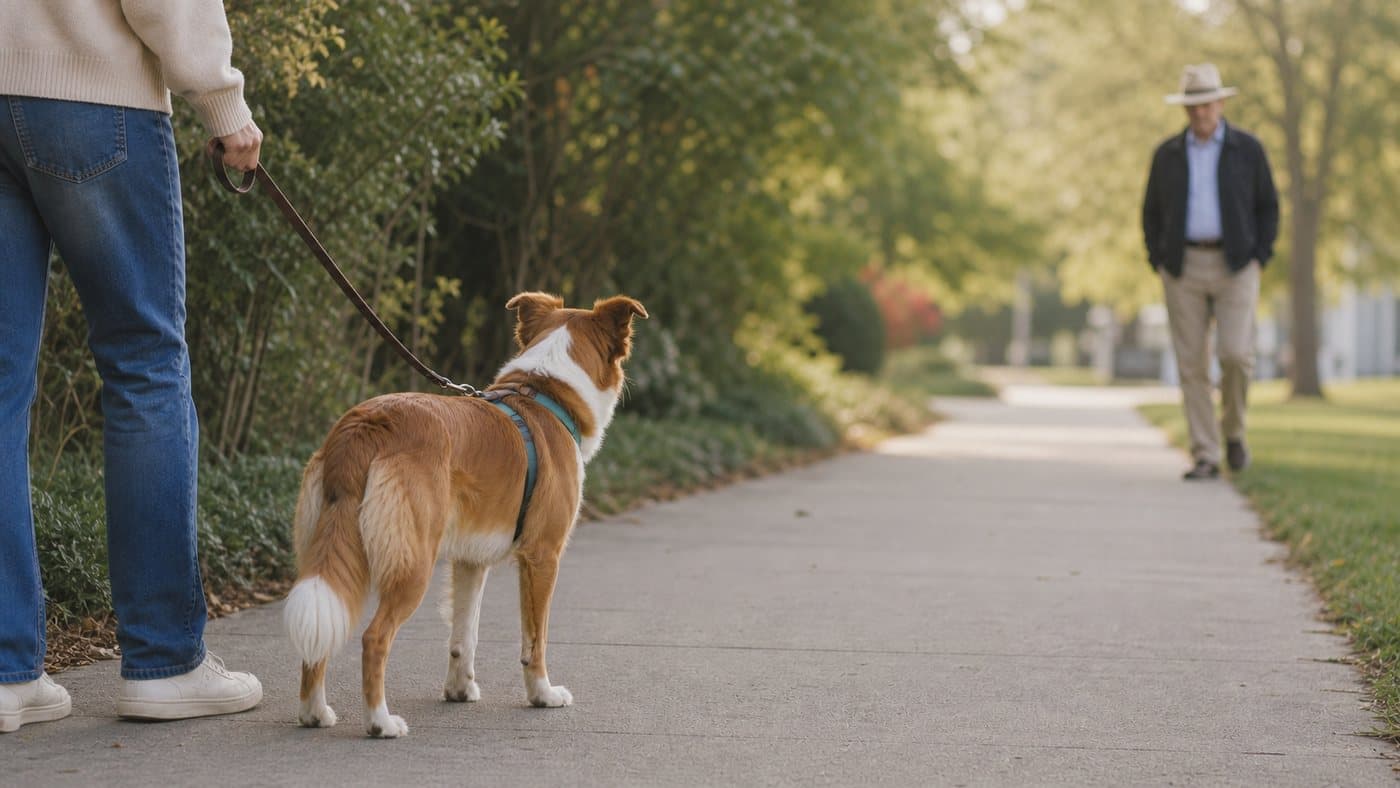
Fear and aggression are not opposites. A scared dog can use aggressive-looking behavior to make something go away. Barking, growling, lunging, snapping, and biting are often distance-increasing behaviors.
The useful question is not "Is my dog scared or aggressive?" It is "What is my dog trying to change about this situation?"
Fear often asks for distance
Fear-based behavior often includes weight shifted backward, tucked tail, ears back, crouching, avoidance, lip licking, whale eye, trembling, or trying to hide. Some dogs bark while backing up. Others freeze first, then explode if the trigger keeps coming closer.
Fear can also look forward. A dog may lunge toward a person or dog because previous lunging made the scary thing leave. That does not mean the dog feels confident. It may mean the strategy works.
Risk is a separate question
Risk increases when the dog becomes still and hard, cannot disengage, has a bite history, redirects onto the leash or handler, guards resources, reacts around children, or recovers slowly after the trigger leaves.
Multiple small signals matter. A dog who freezes, closes their mouth, stares, then growls is not "fine until suddenly aggressive." The early signals were part of the sequence.
Two mistakes that make the answer worse
Owners sometimes force greetings to prove the dog is friendly. This can backfire. If the dog is asking for distance, removing the distance teaches them that subtle signals do not work.
Punishing growling is also risky. A growl is a warning. You want to hear warnings early enough to change the situation.
Use pressure changes as evidence
Record the trigger profile: who or what, distance, movement speed, eye contact, sound, location, and whether the dog is on leash or confined. Notice whether your dog moves away when allowed. If distance helps, fear or social pressure may be part of the picture.
Track recovery time. A dog who returns to normal quickly after distance is added may need better management and controlled exposure. A dog who stays distressed for a long time needs a more cautious plan.
Make the next setup safer, not closer
Stop greetings that your dog did not choose. Create distance, use barriers, and reward calm noticing from far enough away that your dog can still eat and think.
If there has been a bite, child exposure, repeated snapping, or unpredictable aggression, consult a vet and qualified behavior professional. A good plan protects everyone while helping the dog feel safer.
A four-part read
First, identify the trigger: person, dog, object, handling, food, child movement, or confinement.
Second, identify the direction: is your dog moving away, freezing, moving forward, blocking, or guarding?
Third, identify recovery: can your dog soften when the trigger leaves or distance increases?
Fourth, identify risk: has there been snapping, biting, child exposure, redirected behavior, or a setup where distance is impossible?
This separates emotion from safety. A dog can be scared and still dangerous in a specific setup. A dog can look forward and intense while still trying to make the trigger go away.
Choose the household response by risk
If the behavior is loud but your dog can move away, take food, and recover quickly, start with distance, easier routes, and no forced greetings. That dog may need confidence work and better setup control.
If the dog freezes, guards an item, blocks a doorway, or reacts around children, treat the situation as higher risk even if no bite has happened. Use barriers and prevent access while you get a better plan. Stillness and blocking deserve more respect than many people give them.
If there has been a bite, repeated snapping, redirected biting, or a person who cannot safely follow instructions, stop DIY exposure. The next step is not another greeting. It is a veterinarian check when relevant, a qualified behavior professional, and a household safety plan.
The wrong example is inviting a stranger closer to "see what happens." The better example is increasing distance until the dog can think, then collecting video and notes from that safer setup.
The distance test
Distance is one of the cleanest clues. If your dog softens when the person, dog, or object moves farther away, fear or social pressure is likely part of the pattern. Softening may look like eating again, sniffing, turning away, lowering the tail, or taking a breath.
If the dog gets more intense as the trigger retreats, there may be frustration, chase history, guarding, or conflict. Either way, the answer is not to force the dog closer. The answer is to learn what distance makes thinking possible.
Safety management is not failure
Use gates, leashes, muzzles trained with positive reinforcement, closed doors, and planned routes when risk is present. Management prevents bites while you build skills. It also protects the dog from being put in situations where they feel forced to escalate.
A muzzle should never be slapped on during a crisis. It should be conditioned slowly with food so the dog willingly puts their nose in and feels comfortable wearing it.
What to tell a professional
When you seek help, bring specific observations: trigger, distance, body language, recovery time, bite history, medical changes, and videos if safe to collect. "My dog is aggressive" is less useful than "My dog freezes and growls when unfamiliar men reach over her head within three feet."
Good professionals will ask about health, environment, management, reinforcement, and safety. Be cautious of anyone who promises a quick fix through fear or suppression.
Why labels can get in the way
The word "aggressive" can make people rush toward control. The word "scared" can make people excuse risk. Neither label is enough by itself. A scared dog can still bite. A dog who lunges forward may still be trying to make space. The plan has to match both emotion and risk.
Instead of arguing over the label, describe the sequence. What did the dog notice? What did their body do first? What did the trigger do? What made the dog soften? This sequence gives you a safer plan than a single adjective.
Watch recovery after the trigger leaves
Recovery is one of the most useful clues. If your dog can sniff, eat, shake off, and return to normal after distance is added, you may have a workable training window. If your dog stays hypervigilant for ten minutes, refuses food, or reacts to smaller things afterward, the overall stress level is too high.
Plan the next exposure based on recovery. A dog who recovers slowly needs fewer triggers, more distance, and more decompression between hard moments.
The safest default
When you are unsure, choose distance and management. Do not force a greeting to find out whether your dog is "really aggressive." Do not let people reach in because the dog has never bitten before. A cautious setup gives you better information and keeps the dog from practicing louder warnings.
Safety first gives behavior change room to work.
It also gives you cleaner information, because the dog is no longer forced into panic. The practical answer is often not a single label. It is a safer setup, a better read of the sequence, and help when the risk is bigger than a household can manage alone.