
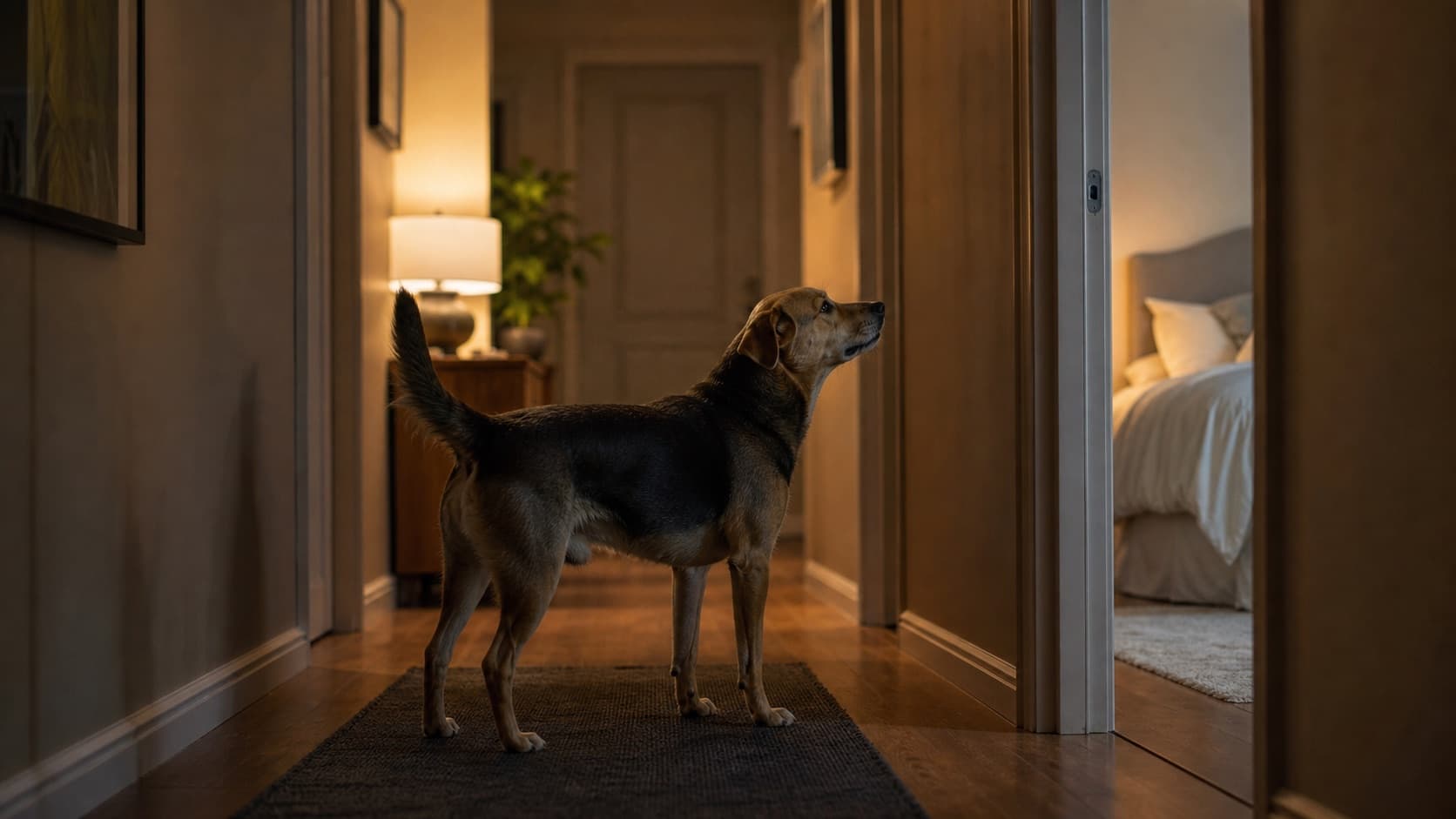
A dog who growls at night can make the whole house feel tense. Maybe they stand in the hallway and rumble at nothing you can see. Maybe they growl from the bed when someone moves. Maybe the growl started suddenly after years of quiet nights.
Growling is not a behavior to punish out of the dog. It is information. Your dog is saying something feels unsafe, uncomfortable, surprising, or too close. At night, that message deserves a careful look because darkness, quiet sounds, sleep, pain, and routine changes can all change how a dog feels.
Why night can change behavior
Night is a different environment. The house is quieter, so small sounds stand out. A neighbor's car door, footsteps in an apartment hallway, pipes, wildlife, wind, or a furnace cycling on can seem much more important after dark.
Vision also matters. Some dogs are more startled when they cannot clearly see who is moving. Senior dogs may have hearing or vision changes that make normal household motion feel unpredictable.
Sleep changes the picture too. A dog who is woken suddenly may growl before they fully understand what happened. A dog who is uncomfortable may be more irritable after trying to rest. A dog who has had a stressful day may have less patience by bedtime.
Four patterns to sort first
Alert growling often comes with orientation. The dog points toward a window, door, wall, hallway, or yard. They may bark after growling, then settle once the sound stops.
Fear-based growling may look tighter. The dog may freeze, tuck the tail, pin the ears, pant, pace, refuse to move forward, or retreat after growling.
Resting-place growling happens when someone approaches the bed, couch, crate, or dog bed. The dog may stiffen, show whale eye, lower the head over the resting spot, or growl when touched or moved.
Pain-related growling may appear with trouble getting up, reluctance to jump, licking one body part, panting, restlessness, appetite changes, or irritability when handled.
Labels that do not help
Do not assume your dog is being dominant. That label does not tell you what triggered the growl or how to make the situation safer.
Do not assume your dog is "growling at nothing." Dogs can hear and smell things people miss. They can also react to discomfort, confusion, or shadows.
Do not correct the growl before you understand it. Punishing a warning can make the dog quieter without making them more comfortable. A dog who stops warning may still feel unsafe.
Keep a one-week night log
For one week, write a short night log. Record the time, location, what your dog faced, who moved, what happened earlier that day, and how long recovery took.
Notice whether the growling happens from sleep, from a resting place, near a doorway, near windows, or when a specific person moves. Notice whether your dog can take food afterward. A dog who can quickly take a treat and settle is in a different state than a dog who stays stiff, refuses food, or keeps scanning.
If the growling is new, track physical signs too: limping, stiffness, trouble lying down, drinking more, house soiling, appetite changes, confusion, coughing, vomiting, or sensitivity to touch.
Change the bedtime setup tonight
Give your dog more space at night. Avoid reaching over, grabbing collars, pushing them off furniture, or waking them by touch. Call their name softly from a distance and wait for them to orient before moving closer.
Use management while you gather information. Close blinds, add steady white noise, block access to a triggering window, and create a comfortable sleeping area where people do not step over the dog.
If the growl happens around a bed or couch, do not pull the dog off. Teach an easy "off" cue during the day with treats, and offer a high-value reward for moving to another bed. At night, prevention is safer than confrontation.
When a veterinary check matters
Sudden night growling should be taken seriously. Pain, sensory changes, urinary urgency, nausea, skin discomfort, orthopedic problems, cognitive changes, and medication effects can all show up as nighttime irritability.
Contact a veterinarian if the growling is new, increasing, linked to touch, paired with restlessness, or happening in a senior dog. A qualified behavior professional can help when the growling involves people, resting places, guarding, or repeated fear patterns.
A safer bedtime routine
Make the last hour predictable. Calm bathroom break, quiet room, dimmer lights, no rough play, and a sleeping spot away from traffic paths. If your dog is sensitive to hallway noise, try white noise near the resting area. If your dog seems uneasy in the dark, add a soft night-light.
Give each dog in the home a separate resting space if tension appears around beds, people, or doorways. Night is not the time to test whether dogs will share.
If the growl happens in bed
Do not take it personally. A dog on a human bed may be startled by legs moving, blankets shifting, or a person rolling toward them. They may also feel trapped because the space is narrow.
The safest answer may be a separate dog bed beside the human bed, at least while you rebuild comfort. Reward the dog for choosing that spot before bedtime. If they come onto the bed and later growl when moved, the setup is already too difficult.
The useful endpoint
The goal is not to silence the growl. The goal is to understand why the growl is happening and reduce the pressure that caused it. A dog who feels safe, comfortable, and able to move away has less reason to warn.
If there is any risk of a bite, a child being involved, guarding, sudden behavior change, or pain signs, use management now and get professional support. Night growling is solvable more often when it is treated as a clue, not a challenge.