
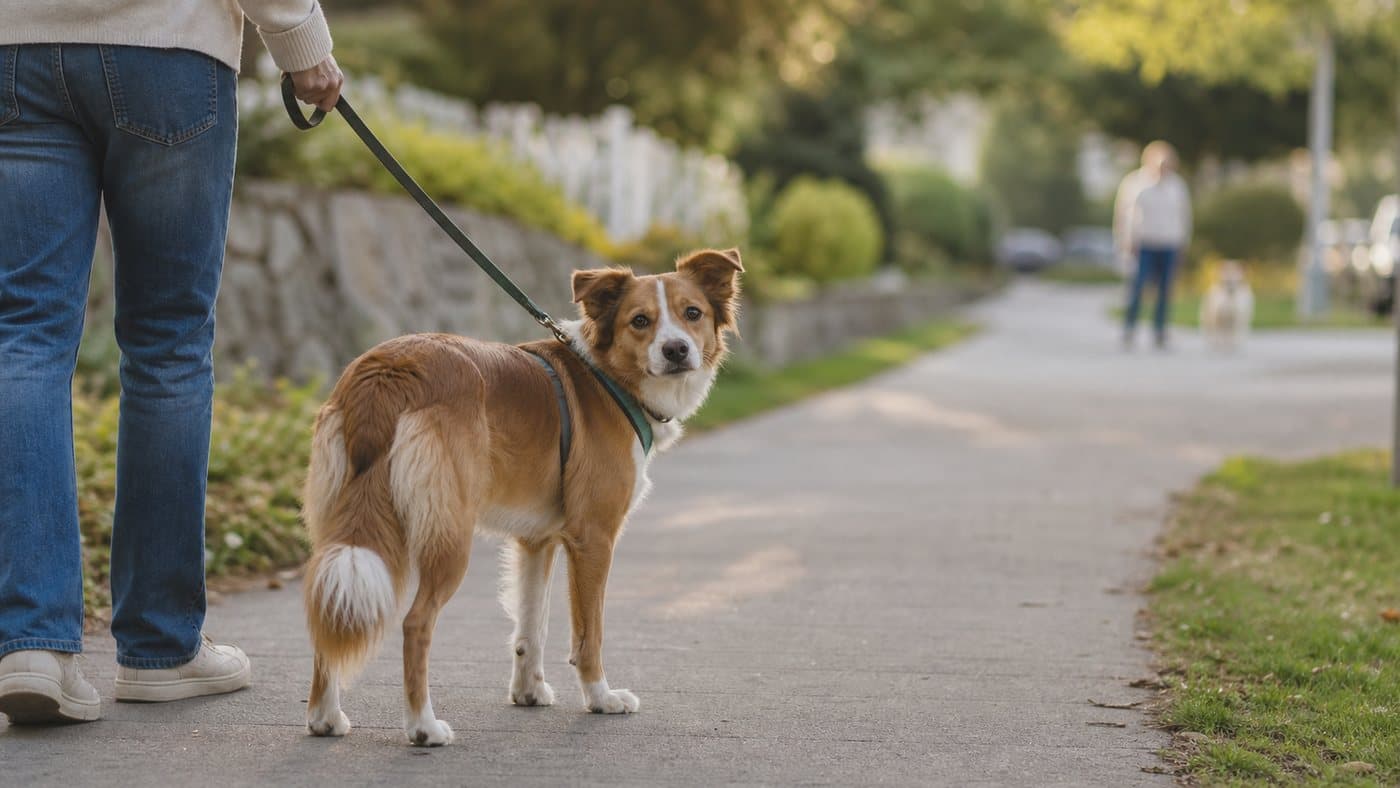
If your dog barks at other dogs, the first question is not "How do I stop it?" The better question is "What is the bark doing for my dog in this exact moment?"
Dog-to-dog barking can mean several different things. A dog who barks with a loose body, curved movement, play bows, and quick recovery may be frustrated because the leash blocks greeting. A dog who barks with weight shifted backward, ears pinned, a closed mouth, and a stiff tail may be asking for distance. A dog who explodes only at the fence or window may be rehearsing a barrier pattern: the dog barks, the other dog eventually leaves, and the barking feels effective.
Where it happens changes the meaning
On walks, barking often starts before owners think it starts. Your dog may spot another dog half a block away, freeze for one second, close their mouth, lift their head, then bark only when the other dog gets closer. That first freeze is useful information.
At windows, the pattern is different. Your dog may patrol the same sight line every day. The trigger appears, your dog barks, the trigger passes, and the brain logs a win. Over time, the barking can become faster and easier to trigger.
At fences, dogs may sound intense because the fence creates pressure. They cannot move normally, sniff, curve away, or choose distance. Barrier frustration can look dramatic even when the same dog is calmer off leash in a controlled setting.
Loud does not automatically mean aggressive
Owners often call this behavior "aggression" because it is loud. Volume alone is not enough. Look for stiffness, hard staring, forward weight, piloerection, redirected biting, inability to disengage, and slow recovery. Also notice the opposite: bouncing, whining, spinning, and quick glances back at you often suggest arousal or frustration rather than a plan to harm another dog.
Do not correct the bark by jerking the leash or forcing your dog closer. That can make the other dog predict discomfort. The goal is to change the emotional setup, not just silence the sound.
Find the distance where thinking is still possible
Write down the distance where your dog first notices another dog and can still take food. That is your working distance. Note whether head-on approaches are worse than parallel movement. Track whether your dog reacts more after multiple triggers, in narrow spaces, at dusk, or when you are tense on the leash.
Also watch recovery. A dog who can sniff the ground, eat, and soften within 20 seconds is in a different place than a dog who stays locked on for five minutes.
Change the walk before asking for obedience
For one week, choose distance over obedience. Cross the street early, use parked cars as visual breaks, and reward your dog the moment they notice another dog without exploding. Say a simple marker like "yes," then feed near your leg while moving away in a curve.
If your dog has snapped, redirected onto the leash or handler, bitten, or is exposed to children or small dogs at close range, bring in a qualified trainer or veterinary behavior professional. Safety planning is not failure. It is how good behavior work begins.
A quick read of the bark
If your dog barks while backing up, refusing food, or trying to leave, treat the reaction as worry first. Give distance and make the next exposure easier.
If your dog barks while pulling forward with a loose, bouncy body and recovers quickly, frustration may be a bigger piece. That dog still needs distance, but they also need a clear pattern for seeing a dog, checking in, and moving on.
If the barking happens mainly behind fences, windows, or car doors, the barrier may be driving the rehearsal. The first fix is not a harder correction. It is reducing the number of times your dog gets to practice the full bark-until-the-dog-leaves sequence.
Choose the next move from the pattern
Use the bark pattern to choose the next walk decision. If your dog sees another dog and can still eat, mark the look, feed, and arc away before the stare gets hard. If your dog sees the dog and immediately freezes, skip cues for a moment and create distance with your own body movement. If your dog is already barking, do not stand still asking for a sit. Move away, let the body soften, then feed after one small recovery sign.
If your dog is friendly off leash but erupts on leash, treat the leash picture as real instead of dismissing it. Work on wider passes, looser leash handling, and fewer forced greetings. If your dog is calm on walks but intense at the window, the training target is rehearsal: block the view during busy times and teach a reset away from the glass. If your dog barks at the fence, reduce unsupervised fence time before practicing calm looks at distant dogs.
The common mistake is using one answer for every pattern. A worried dog does not need a closer greeting. A frustrated dog does not need more leash tension. A barrier-barking dog does not need more hours at the lookout station.
A real walk example
Imagine a dog who is quiet in the car, relaxed in the driveway, and then barks when a Labrador appears across the street. The owner may experience that as "zero to one hundred," but the dog may have shown a sequence: head lift, mouth close, weight forward, tail rise, one second of stillness, then barking. That sequence tells you where training needs to begin.
The useful training moment is not the bark. It is the first orienting moment. If your dog can notice the Labrador and still turn back for food, you are at a workable distance. If your dog cannot eat, cannot hear you, and cannot turn away, you are too close for learning.
What to write down after one reaction
- What kind of dog triggers the bark: small, large, fast-moving, staring, barking, or all dogs?
- Is your dog worse on narrow paths, corners, elevators, apartment hallways, or head-on sidewalks?
- Does your dog recover faster when you move away in a curve instead of standing still?
- Does leash tension appear before the bark?
- Can your dog take food after seeing the other dog?
A seven-day reset plan
For seven days, skip routes where you know your dog will be trapped near other dogs. This is not avoidance forever. It is reducing rehearsal so the nervous system can come down.
On each walk, mark and feed when your dog notices a dog at a safe distance. Then move away before barking starts. If your dog barks anyway, add distance without scolding, wait for one small recovery sign, and feed after the dog can disengage.
At home, practice the same pattern with easier sights: a person across the street, a dog far away from a window, or a calm dog in a parking lot. The goal is not perfect silence. The goal is a dog who can see a trigger, stay under threshold, and choose to turn back.
When the plan needs more support
Bring in a professional if your dog redirects onto you, bites the leash, cannot recover after the other dog leaves, or reacts at distances you cannot realistically manage. Also get help if the barking happens around children, small dogs, apartment hallways, elevators, or shared building entrances where distance is limited.
Good help should make the walk feel calmer and more predictable. It should not require frightening the dog, flooding them with close greetings, or punishing every bark. The safest plan starts with distance, body language, controlled setups, and a handler who knows what to do before the bark happens.
The evergreen rule
Treat barking at other dogs as information about distance, pressure, and recovery. A useful plan makes the dog easier to read before it makes the bark disappear. If the setup lets your dog notice another dog and still think, you have something to train. If the setup produces instant barking every time, the setup is still too hard.