
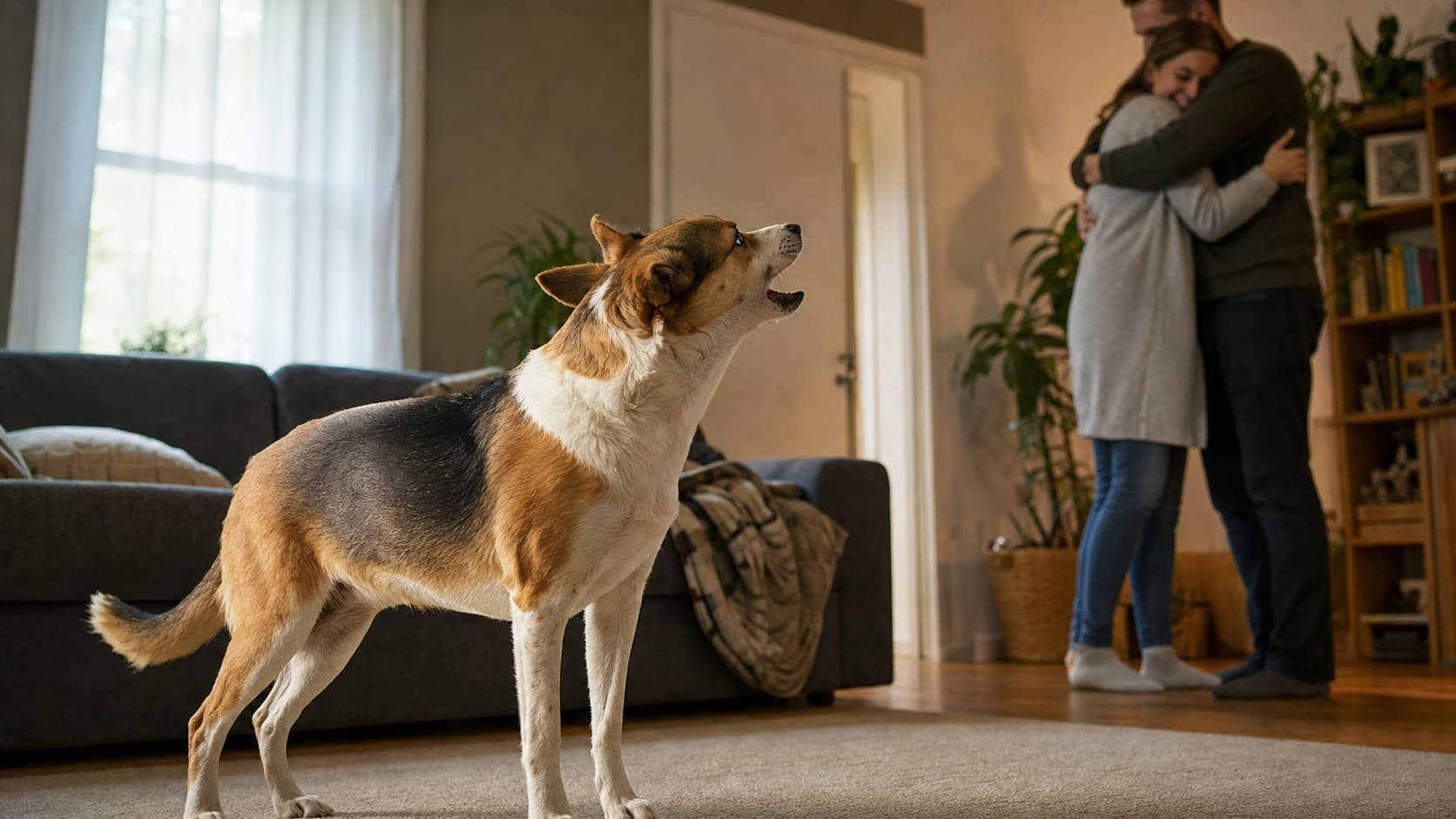
You lean in to hug your partner, a friend, or a child, and your dog suddenly barks. Maybe they rush between you. Maybe they bounce, paw, whine, or grab a toy. It can look funny at first, but it can also feel confusing. Is your dog jealous? Protective? Trying to stop a fight?
Most dogs are not reading a hug the way people do. They are reacting to movement, closeness, emotion, and a sudden shift in attention. A hug puts two bodies close together, changes posture, and often creates tension in the room. To a dog, that can be exciting, strange, or socially uncomfortable.
Four reasons dogs interrupt hugs
Hug barking usually falls into a few patterns.
Some dogs bark because hugs are exciting. People move quickly, laugh, speak in higher voices, or squeal. The dog joins the burst of energy and learns that barking gets everyone to look at them.
Some dogs bark because close human body contact looks tense. Dogs do not hug the way people do. In dog body language, leaning over, holding still, wrapping arms, and face-to-face closeness can be intense signals. Your dog may be saying, "This looks weird. I am not sure about it."
Some dogs bark because attention shifted away from them. If your dog often gets interaction when they interrupt, the bark can become a reliable way to re-enter the moment.
Some dogs bark because one person moving toward another has predicted rough play, loud voices, wrestling, or conflict in the past. Even if the current hug is friendly, the dog may react to the shape of the scene.
Body language to watch
Do not judge the bark by volume alone. Watch the rest of your dog's body.
A playful or attention-seeking dog may have a loose body, bouncy movement, open mouth, quick recovery, and a tendency to bring a toy or jump around.
A worried dog may stand stiffly, lean forward, stare, tuck the tail, pin the ears, lip lick, yawn, pace, or move between people with a tight body. Some dogs bark and then retreat. Others bark and push closer because distance feels unavailable.
A dog who escalates to growling, snapping, hard staring, blocking, or mouthing needs more careful management. That does not mean the dog is bad. It means the situation is too hard to treat like a joke.
Do not romanticize it as protection
Do not assume your dog is "protecting" one person in a heroic way. Some dogs are anxious about proximity, movement, or social tension. Calling it protection can make owners miss the stress underneath.
Do not assume your dog is being spiteful or jealous in a human sense. The dog may simply have learned that barking during hugs changes the scene.
Do not scold the dog for barking without changing the setup. If the bark comes from worry, punishment can make hugs feel even more uncomfortable. If the bark comes from attention seeking, big reactions can make the habit stronger.
Test the shape of the hug
Try to notice patterns for a few days.
Does your dog bark only when you hug one specific person, or during all hugs? Do they react to slow hugs, quick excited hugs, children running in for a hug, or playful wrestling? Do they bark when people dance, shake hands, pick up a child, or sit close on the couch?
Also notice distance. Can your dog watch a hug from across the room without barking? Can they handle a one-second side hug but not a long embrace? Can they eat a treat while watching, or are they too tense to take food?
These details tell you whether the plan should focus on excitement, attention, fear, or safety.
Make a one-second hug boring
Start by making hugs boring and predictable. Do not begin with the hardest version. Practice with two adults, plenty of space, and a calm dog.
Place a mat or dog bed several feet away. Before the hug, scatter a few treats on the mat or cue an easy behavior your dog already knows. One person gives a short, calm side hug for one second. Then the hug ends and more treats appear on the mat.
The goal is not to distract forever. The goal is to teach your dog that human closeness predicts calm rewards and that they have a clear place to be.
Keep the first sessions short. If your dog barks, stiffens, or rushes in, make it easier. Increase distance, shorten the hug, lower the excitement, or practice with a less triggering person.
If your dog rushes between people
Blocking or body-splitting can be social, anxious, or attention-based. Give your dog a better job before the rush starts. A mat, a treat scatter, a chew, or a simple "go find it" game can help the dog move away from the pressure point.
Avoid pushing the dog back with your hands. That can add frustration and body pressure. Use distance, barriers, and rewards instead.
If children are involved, manage the scene closely. Children should not test whether the dog will "get over it." Use gates, distance, and adult supervision. If the dog has growled, snapped, or bitten around hugs or children, stop practicing on your own and contact a qualified behavior professional.
A calmer training setup
Practice when the house is quiet, not during greetings, parties, or emotional moments. Put treats in a bowl out of reach before you start. Ask your dog to go to their mat. Reward. Two people lean slightly toward each other. Reward. Then touch shoulders. Reward. Then one-second hug. Reward. End before the dog gets loud.
Over time, increase one detail at a time: longer hug, closer distance, more movement, or a different person. If you increase everything at once, you will not know what your dog can handle.
When hug barking becomes a safety issue
Get support if the barking is paired with growling, snapping, biting, hard blocking, intense guarding of one person, or panic. Also get help if the behavior appears suddenly, especially with pain signs, irritability, or other behavior changes.
For mild barking, the first win is simple: your dog can watch a calm hug from a comfortable distance and recover quickly. That is much more useful than forcing them to accept a full human hug up close.