
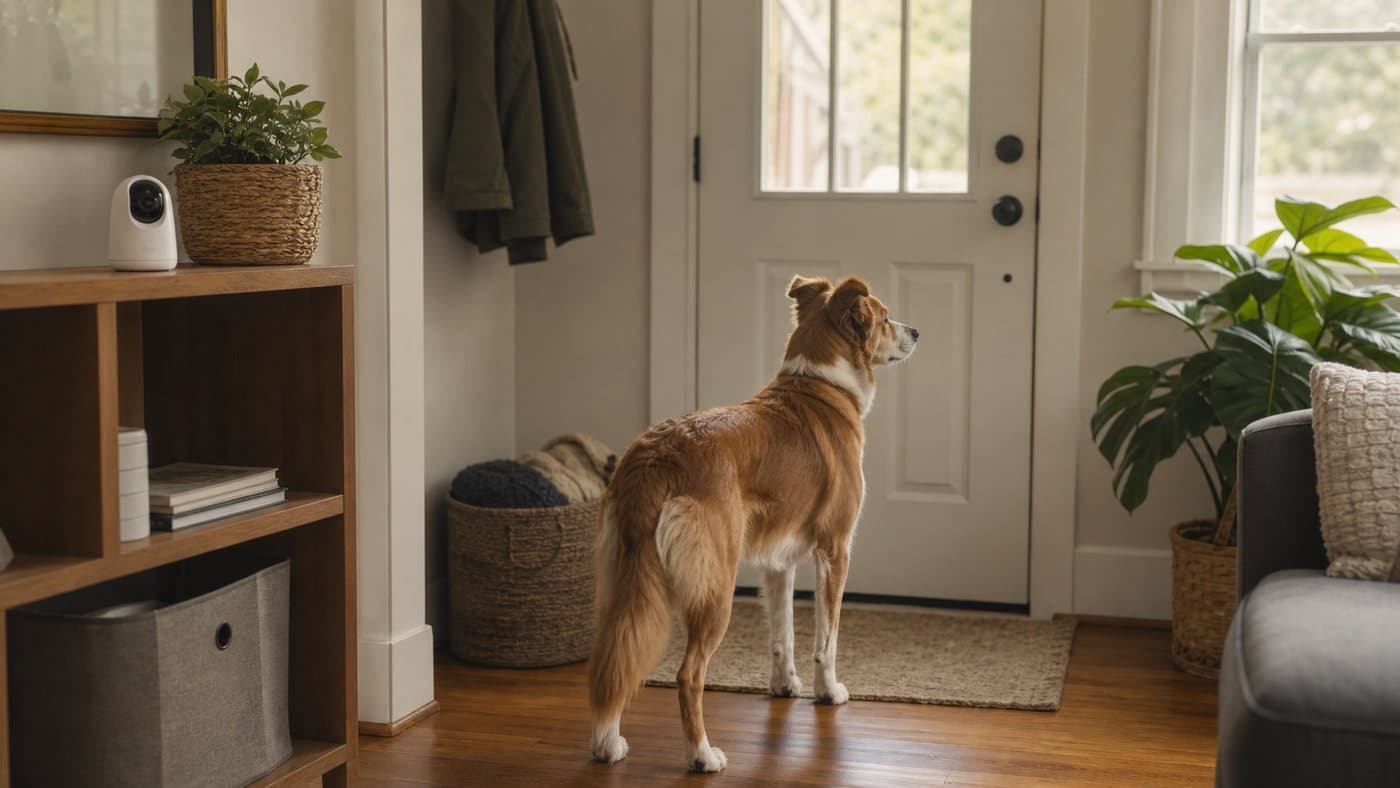
Separation anxiety is not a dog being dramatic, spoiled, or spiteful. It is a distress response that appears when the dog is separated from a person or from social contact they rely on.
The only reliable way to understand it is to look at what happens when the dog is actually alone or believes they are about to be alone.
Signs that point toward panic, not protest
Common signs include pacing, repeated barking or howling, door or window scratching, drooling, trembling, escape attempts, destruction near exits, urination or defecation in an otherwise house-trained dog, and inability to eat a favorite treat until the owner returns.
Timing matters. A dog who panics in the first few minutes of absence is different from a dog who becomes bored after four hours with no enrichment. A dog who reacts to shoes, keys, bags, or a specific exit routine may be anxious before the person has even left.
Video is more useful than guessing. Many owners discover that the worst distress happens in the first 10 minutes, long before neighbors complain or damage is noticed.
Problems that can look similar
Boredom can create chewing, digging, or barking, but the dog may still eat, explore, rest, and shift between activities. Confinement distress can look like separation anxiety when the dog panics in a crate but relaxes in a dog-proofed room. Barrier frustration can appear when a dog can see people leaving but cannot follow.
Medical issues can also change behavior. Sudden house soiling, restlessness, vocalizing, and clinginess can come from pain, urinary problems, gastrointestinal distress, cognitive changes, or medication effects.
Avoid the two common mistakes
Do not punish the dog after you return. The dog will not connect the punishment to the earlier panic. Do not use bark collars, shock collars, or intimidation to suppress distress sounds. Silencing panic does not make the dog feel safe.
Also be careful with "let them cry it out." Some dogs do not habituate. They sensitize, meaning the fear grows.
The other mistake is assuming every alone-time problem is separation anxiety. If the dog eats normally, sleeps after a few minutes, and only chews available objects later in the day, the plan may be management and enrichment rather than desensitization.
What to capture on video
Record departures at different lengths: 30 seconds, two minutes, five minutes. Note the first sign of distress, whether your dog eats, whether the behavior happens only in the crate, and how long recovery takes after you return.
Pay attention to body language: panting when it is not hot, scanning, repetitive routes, dilated pupils, drool, and frantic greetings can all matter.
Find the shortest safe absence
Create a baseline before training. Choose a very short absence your dog can handle, even if it is only walking to the mailbox. Return before panic. That safe duration is where desensitization begins.
If your dog injures themselves, destroys crates or doors, drools heavily, refuses food during absences, or cannot be left for necessary life routines, contact a veterinarian and a separation-anxiety specialist.
How to review a video
When you watch a departure video, look minute by minute instead of only watching the dramatic parts. Write down the first sign: standing at the door, scanning, panting, whining, scratching, howling, or lying down. The first sign tells you where the distress begins.
Also record whether your dog changes rooms, checks windows, drinks water, eats, lies down, or repeats the same route. Repetitive loops can point to panic. A dog who explores and then rests may be dealing with boredom or mild frustration instead.
A simple sorting guide
If distress starts before you leave, watch the departure cues: shoes, keys, bag, coat, garage door, or the crate routine. The dog may be reacting to the prediction, not only to the absence.
If distress starts only after confinement, test a safer room or gated area. A dog who panics in a crate but rests loose in a dog-proofed room may need confinement work before absence work.
If the dog is quiet for hours and then chews or barks later, look at exercise, sleep, food puzzles, window access, and boredom. That pattern is still worth solving, but it is not the same as immediate panic.
A safe absence ladder
A useful ladder might look like this: touch the doorknob, open the door, step out for one second, step out for five seconds, walk to the end of the hall, start the car, return after 30 seconds. The right step depends on your dog's baseline, not on a generic schedule.
Only increase difficulty when your dog stays relaxed at the current level. If the dog vocalizes, scratches, or refuses food, the ladder jumped too far. Go back to the last easy step and make the next repetition smaller.
Management while training
Separation training is much harder if the dog keeps having panic-level absences. Use daycare, trusted sitters, family help, remote work changes, or errand batching where possible. Management is not the cure, but it prevents the fear from being rehearsed while you teach the dog a new expectation.
If your life cannot avoid absences, a veterinarian may be able to discuss medical support as part of a broader behavior plan.
Clues that point away from separation anxiety
Not every alone-time problem is separation anxiety. A young dog who chews shoes after two quiet hours may need more management, sleep, and appropriate outlets. A dog who barks only at hallway noise may be reacting to sounds, not absence. A dog who panics only inside a crate but relaxes loose in a safe room may have confinement distress.
The distinction matters because the plan changes. Boredom may improve with exercise, enrichment, and a dog-proofed space. Noise-triggered barking may need sound masking and window or hallway management. Confinement distress may require changing the setup before you work on leaving.
Video helps you avoid guessing. Watch whether the dog is focused on exits, your scent, food, noises, the crate door, windows, or random objects. The target of the behavior often tells you what the dog is actually worried about.
A practical decision tree
Start with the first minute. If your dog is already pacing, vocalizing, scratching, or refusing food before the door closes, treat departure cues as part of the problem. Practice those cues without leaving before you build longer absences.
If the first minute is calm but your dog reacts to the crate door, compare the crate with a gate or safe room. Do not keep increasing crate duration if confinement is the first trigger. Rebuild confinement comfort separately or use a safer area while you work.
If the dog is calm for a long stretch and then barks at a hallway sound, window movement, or delivery, the first plan is environmental management. If the dog is quiet, eats, rests, and later chews available items, start with dog-proofing, sleep, exercise, and enrichment.
If the dog cannot eat, keeps returning to exits, drools, howls, or tries to escape in every setup, stop testing and get qualified help. That pattern is bigger than a simple manners plan.
What progress usually looks like
Progress is rarely a straight jump from panic to four-hour naps. It often starts with tiny signs: your dog eats after you step out, lies down for 20 seconds, stops following every pre-departure cue, or recovers calmly when you return. These small changes matter because they show the nervous system is learning that absence can be survivable.
Avoid testing progress with a long errand too early. A single absence that is too difficult can bring back the old panic pattern. Build duration gradually, keep notes, and protect your dog's successful reps.
When to stop guessing
Get help sooner if the dog injures themselves, tries to escape through doors or windows, drools heavily, refuses food during every absence, or cannot be left for necessary life routines. The goal is not to prove the label. The goal is to keep the dog safe while you build a plan that starts below their panic point.