
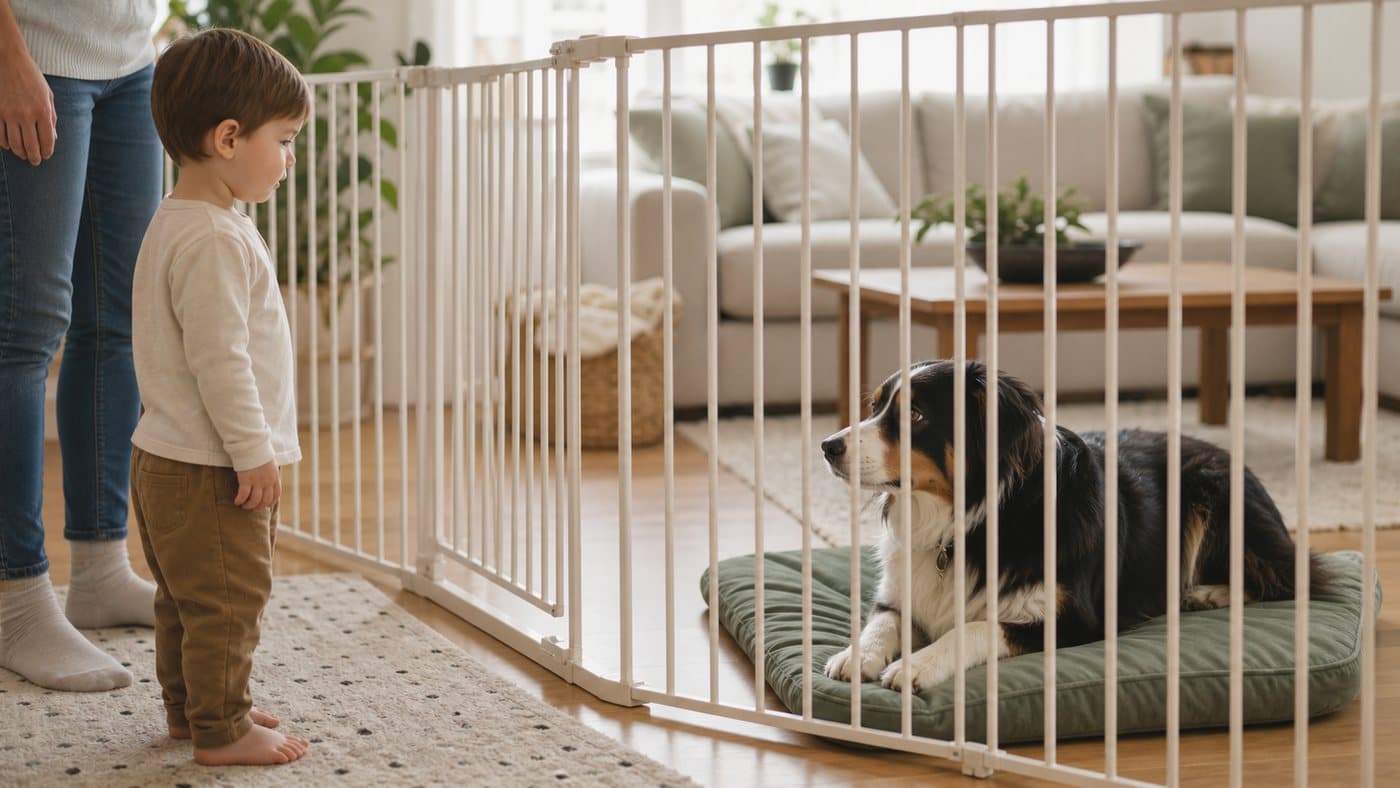
If your dog growls at a child, treat it as important safety information. The growl means the dog is uncomfortable and needs distance. Punishing the growl can remove the warning without making the child safer.
First move: create distance
Calmly separate the dog and child. Use a gate, door, leash, or adult body block. Do not scold the dog or ask the child to "try again." The goal is to prevent escalation.
Then identify the pressure point
What was the child doing? Hugging, reaching, running, touching a toy, approaching food, climbing on the dog, waking the dog, or entering the dog's resting space? Did the dog show earlier signals like turning away, whale eye, lip licking, freezing, or moving away?
Use a household safety rule immediately
Children should not approach eating, sleeping, chewing, hiding, or cornered dogs. Use management even if the dog has never bitten. Adult supervision means active prevention, not watching from across the room.
Contact a vet and qualified behavior professional. Child safety cases deserve individualized help.
Do not remove the warning
A growl is not the dangerous part to punish away. It is the early warning that lets adults intervene. If a dog learns that growling gets them scolded, grabbed, or trapped, they may stop warning and move more quickly to snapping or biting.
The safer goal is to understand what made the dog uncomfortable and prevent that situation from repeating. That means changing supervision, space, and routines immediately.
Common child-dog pressure points
Many children behave in ways adults see as affectionate but dogs experience as intense. Hugging, face-to-face staring, lying on the dog, taking toys, running past food bowls, climbing into beds, and waking a sleeping dog are common triggers. Even a gentle child may move unpredictably or miss subtle signals.
Dogs may also guard resting places, food, chews, stolen items, or a favored adult. A growl near a couch, bed, crate, bowl, or toy should be treated as a management issue right away.
What active supervision looks like
Active supervision means the adult is close enough to interrupt before the dog needs to warn. It is not checking from another room or assuming a familiar dog will tolerate everything. Use gates, pens, closed doors, leashes held by adults, and separate rest zones.
Teach children simple rules: do not wake the dog, do not climb on the dog, do not approach when the dog is eating or chewing, and do not follow a dog who walks away. The dog should have an escape route and a protected space where children never enter.
Next steps after one growl
Write down the exact scene. Who was present, what object or space was involved, and what happened in the thirty seconds before the growl? Then prevent that scene while you arrange help.
A veterinary check matters because pain can lower tolerance. A qualified behavior professional can help design a household plan. Until then, choose separation and management over "testing" whether it happens again.
Safer child-dog pressure looks quieter
Progress is not the child petting the dog again quickly. Progress is fewer risky setups, clearer household rules, and a dog who can rest without being approached. In child safety cases, management is part of the solution. Gates, doors, and protected dog spaces are responsible tools, not overreactions.
A safer room setup
Think about the room from the dog's point of view. A dog resting in a corner, on a couch, under a table, or beside a favorite adult may feel trapped when a child enters quickly. A safer setup gives the dog distance, a clear exit, and a place where the child does not follow.
For many homes, that means a gate between the child area and the dog area. The dog can see family life without being touched. The child can move normally without accidentally crowding the dog. If the dog relaxes behind the gate, that is useful information: the problem may be pressure and access, not a dog who is "mean with kids."
Do not ask the child to hand-feed treats to fix the issue. That can pull the child closer to a dog who already gave a warning. Food work around children should be planned by a qualified professional when risk is present.
How to explain it to a child
Children do better with simple rules than long explanations. Try rules like: "If the dog walks away, we let him go." "We do not touch dogs who are sleeping, eating, chewing, or hiding." "We call a grown-up if the dog has a toy we want." These rules protect the child and reduce pressure on the dog.
Avoid framing the dog as naughty or scary. A calmer message is more useful: "The dog is saying he needs space." That helps children learn respect without turning the dog into a villain.
What professional help may include
A force-free behavior professional may help you identify trigger patterns, redesign room access, teach the dog safe retreat behaviors, and teach adults how to interrupt early. A veterinarian may look for pain, skin issues, ear problems, digestive discomfort, or age-related changes that lower tolerance.
Until you have that plan, do not run experiments. Do not see whether the dog will "get over it" with more exposure. One growl around a child is enough reason to change the setup today.
A useful note to keep
After the room is safe, write the scene in plain language: "Child ran toward dog on couch," "child reached for chew," or "dog was asleep under table." Add what the dog did before the growl and what helped them relax afterward. These notes prevent the family from relying on memory, which often softens risky details after everyone calms down. They also give a veterinarian or trainer a clearer starting point.