
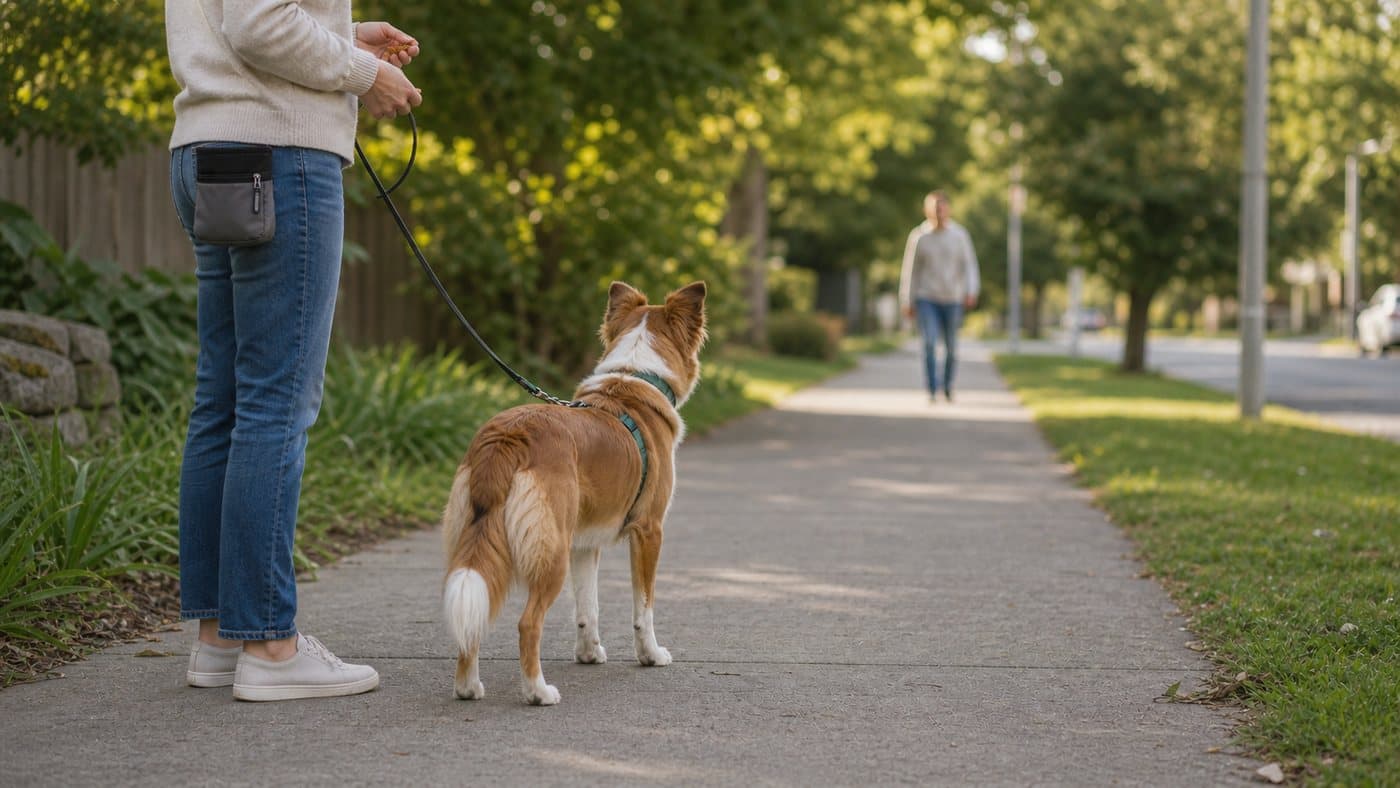
Dogs bark at people on walks for many reasons. A person may appear suddenly, move strangely, stare, reach, run, carry objects, or approach head-on. The leash prevents the dog from choosing normal distance.
Identify the person and the approach
Which people trigger the bark? Men, children, runners, people with hats, people talking, people approaching directly, or people who try to pet the dog? Does your dog bark while moving forward, backing away, or freezing?
Recovery matters. If your dog settles when the person passes, the plan may be distance and counterconditioning. If your dog stays distressed for minutes, choose quieter routes and get help.
Do not let strangers close the gap
Do not let strangers reach toward your dog to prove friendliness. Do not correct barking with leash jerks. If people already worry your dog, corrections can make people predict discomfort.
Protect the working distance
Advocate for space. Cross the street, step behind a car, or turn before your dog explodes. Reward the moment your dog sees a person and remains able to eat. Let the person pass without interaction.
If barking includes snapping, biting, blocking children, or sudden onset, consult a veterinarian and qualified force-free trainer.
Why sidewalks make people harder
It is easy to label this behavior as rude or dominant, but most walk barking is about emotion plus limited options. The leash prevents normal dog choices: curving away, slowing down, sniffing, or creating distance. A sidewalk also forces people to approach in a straight line, which many dogs find intense.
Also watch your own route. A dog who is quiet on a wide trail may bark on a narrow block because the environment gives them less time and space.
Find the working distance
The working distance is the place where your dog can notice a person and still do something else. They can eat, sniff, look back at you, or walk in a curve. That distance may be ten feet for one dog and across the street for another.
Start there. The moment your dog sees a person, mark it with a calm word like "yes," feed, and move in a gentle curve. You are not rewarding the person for coming closer. You are teaching your dog that seeing people predicts good things and that moving away is available.
If your dog barks, you are too close or too late. Do not stand still and argue. Create distance, let the nervous system settle, and make the next repetition easier.
Daily walk setup
Choose routes with escape options: driveways, parked cars, wide grass, or side streets. Walk at quieter times while you build skills. A well-fitted harness and leash can help you move without neck pressure.
Keep sessions short. Five calm person sightings at a good distance are more valuable than a thirty-minute walk full of explosions. At home, practice name response, hand target, and "this way" turns so those cues are familiar before you need them outside.
Get professional help if your dog has bitten, redirects onto the leash or handler, cannot recover after people pass, or reacts strongly to children. Safety and distance are part of training, not a sign that you failed.
The person profile matters
Write down which people are difficult. Some dogs bark mainly at men, children, people wearing hats, people with canes, people carrying bags, runners, delivery workers, or people who stare. Others bark when anyone appears suddenly from behind a car or around a corner.
This is not about judging those people. It is about understanding the picture your dog reacts to. A person standing still across the street may be easy. A person leaning over your dog on a narrow sidewalk may be much too hard.
Advocate before your dog has to bark
Owners often wait until the dog barks, then apologize. Try advocating earlier. Cross the street before the person gets close. Say, "We need space, thank you." Step between your dog and a reaching hand. Turn away from a direct approach.
Your dog should not have to bark to make people back up. When you create space first, barking often becomes less necessary.
People are getting easier to pass when
Progress may start with smaller reactions: one bark instead of ten, faster recovery, looser body, or the ability to eat after the person passes. It may also look like better choices from you: easier routes, earlier turns, and fewer surprise greetings.
Do not measure progress by whether strangers can pet your dog. Many dogs do not need stranger petting to live well. A calm pass-by is a more useful goal for most leash-reactive dogs.
If someone wants to greet your dog
Have a default answer ready before you need it: "No greeting today, we're training." You do not need to explain the whole behavior history. If the person keeps approaching, move away rather than trying to be polite at your dog's expense.
For dogs who may eventually greet some people, start with familiar, calm adults in open spaces. Keep the leash loose, allow the dog to approach and leave, and skip head pats. If the dog barks, freezes, hides, or takes food roughly, the greeting was too hard. Go back to calm pass-bys.