
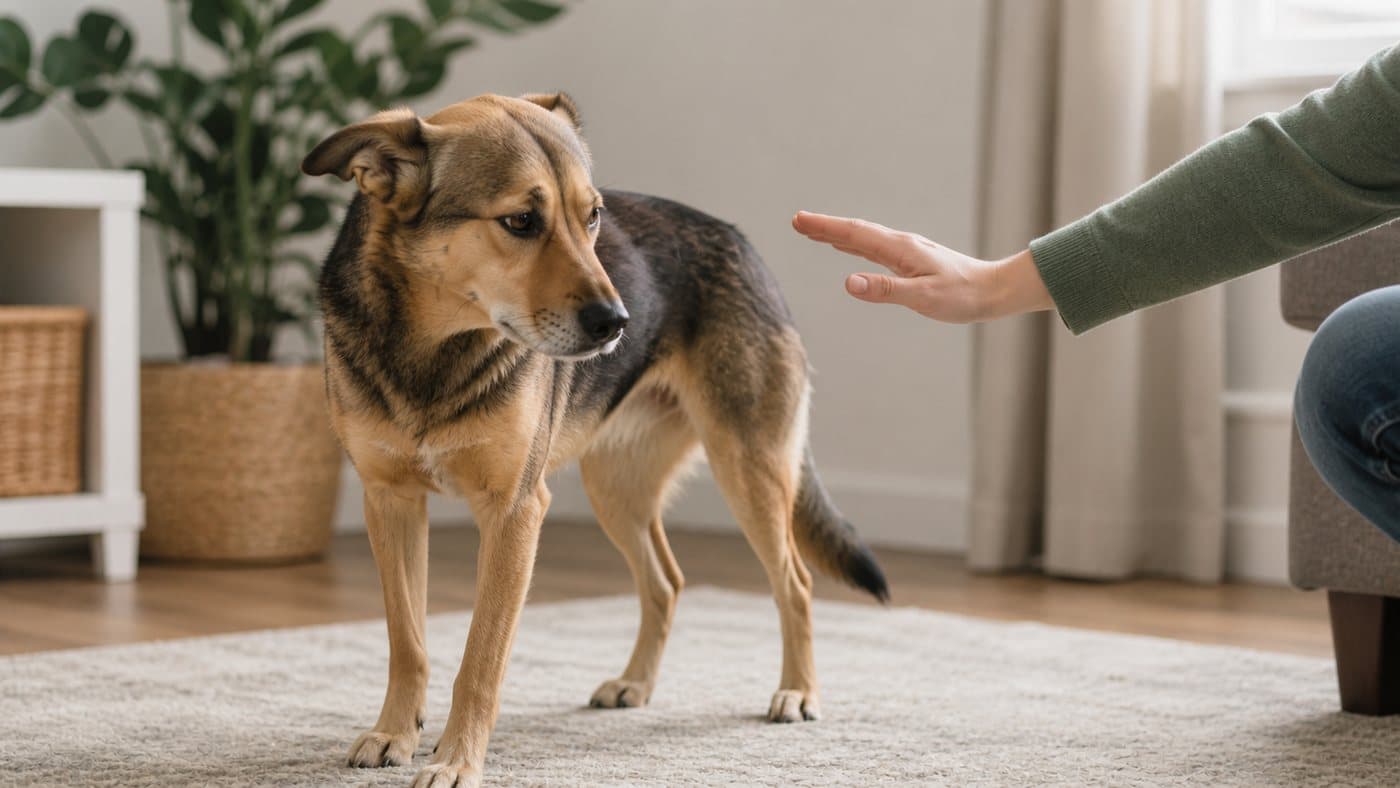
Dog body language is easy to miss because the earliest stress signals are small. By the time a dog barks, growls, lunges, or snaps, they may have already tried several quieter signals that went unanswered.
Learning those early signals helps you prevent bigger behavior instead of reacting after your dog has already escalated.
Small signals that often come first
Common signs include lip licking when no food is present, yawning when the dog is not tired, turning the head away, showing the whites of the eyes, lifting a paw, moving slowly, sniffing suddenly, scratching, shaking off, closing the mouth, freezing, or leaning away.
None of these signals means the same thing every time. Context matters. A dog can yawn because they are sleepy. A dog can sniff because the ground is interesting. The signal becomes meaningful when it appears during pressure: a child hugging, a stranger reaching, a dog approaching, nail trims, photos, restraint, or a crowded room.
Read the whole dog, not one body part
Do not read one body part in isolation. A wagging tail does not automatically mean happy. Look at tail height, speed, body stiffness, mouth tension, eyes, ears, weight shift, and whether the dog can move away.
A relaxed dog usually has soft eyes, loose muscles, curved movement, normal breathing, and the ability to disengage. A stressed dog may become still, intense, or avoidant. Stillness is often more important than noise.
Polite signals people often miss
Many owners miss "please stop" signals because the dog is being polite. A dog who turns away during petting may not be stubborn. They may be asking for a pause. A dog who rolls onto their back may be relaxed, but if the body is stiff and the mouth is tight, it may be appeasement rather than a belly rub request.
Children often miss these signals too, which is why adult management matters. Dogs should not have to escalate to growling to get space from a child.
Watch one ordinary scene first
Choose one daily routine and watch your dog closely: putting on the harness, greeting visitors, being brushed, meeting dogs, or resting while people move nearby. Write down the first signal that appears before your dog moves away, barks, jumps, or mouths.
Then change one thing. Add distance, slow your hands, let the dog approach, or give a break. If the stress signals decrease, your dog has given you useful feedback.
Use a consent pause
Practice consent pauses. Pet for three seconds, stop, and see what your dog does. If they lean in, continue. If they look away, move away, lick lips, or stay still, give space. This simple habit teaches people to notice the dog in front of them.
A signal ladder
Low-level signals might be a head turn, lip lick, yawn, paw lift, sudden sniffing, or looking away. These are useful because you can change the setup early.
Middle signals include freezing, closing the mouth, stiffening, hard staring, moving away, hiding, or refusing food. At this point, stop asking for more and lower the pressure.
High-level signals include growling, snapping, lunging, biting, or frantic escape attempts. Those are not the first signs. They are often what happens after softer signals did not work.
Pause, change, or end the interaction
When you see a low-level signal, pause first. Stop petting, stop reaching, or stop moving closer for a few seconds. If the dog softens and re-engages, continue more gently.
When you see several signals together, change the setup. Add distance, shorten the greeting, move the child away, use food on the floor, or let the dog leave. The goal is not to keep the same interaction going at all costs.
When you see freezing, guarding, growling, snapping, or frantic escape, end the interaction. That is no longer a teaching moment for guests or children. It is a safety moment. A clear stop protects the dog and gives you better information for the next plan.
Read signal clusters, not single signals
One lip lick may mean a crumb, a dry mouth, or stress. A lip lick plus head turn, still body, and leaning away during a hug is a clearer message. Good observation is about clusters.
Ask three questions: What changed right before the signal? Did the dog have room to move away? What happened when pressure decreased? If the signals fade when you add distance or stop touching, the dog was probably asking for less pressure.
Common high-pressure moments
Dogs often show subtle stress during photos, greetings, vet handling, grooming, harnessing, child interaction, being leaned over, or meeting another dog head-on. These moments can look ordinary to people and intense to dogs.
A dog who turns away during a greeting is not being rude. A dog who sniffs the ground when another dog approaches may be trying to calm the situation. A dog who freezes when hugged is not enjoying the hug just because they are still.
Practice with low stakes
Watch your dog during calm daily routines before you try to interpret a hard behavior problem. Learn what relaxed eyes, normal tail carriage, and loose movement look like for your dog. Then stress signals become easier to spot because you know the baseline.
If you live with children, teach them the simplest rule: if the dog moves away, let the dog move away. Respecting that one signal prevents many bigger problems.
A better household rule
The most useful rule is not "never touch the dog." It is "the dog can say no." If the dog moves away, turns their head, freezes, or stops participating, the interaction pauses. That rule helps adults, children, and visitors respond before the dog needs a louder signal.
Watch the recovery, too
Stress signals matter, but recovery tells you just as much. A dog who licks their lips once, steps away, shakes off, and returns to normal breathing may have handled a small moment of pressure. A dog who keeps scanning, stays stiff, refuses food, hides, or startles at every movement is telling you the stress lasted longer than the event.
This is especially useful after greetings. Many owners only notice whether the dog barked, jumped, or allowed petting. Instead, watch what happens after the person stops touching. Does your dog choose to approach again with a loose body, or do they retreat behind you and avoid eye contact? Does the tail return to a natural position, or stay high and tight? Does your dog resume sniffing, chewing, or resting?
Recovery helps you decide whether to repeat an interaction, make it easier, or end it. If your dog needs several minutes to settle after one visitor reaches over their head, the next repetition should be much softer: more distance, no leaning, no reaching, and a chance for the dog to approach on their own.
When subtle signals become a safety issue
Subtle signals deserve more caution around children, crowded spaces, food, pain, and restraint. A dog who freezes when a child hugs them is not being patient in a way you should test. A dog who turns away during grooming may be asking for a pause before growling becomes necessary.
If stress signals are paired with snapping, biting, guarding, sudden personality changes, limping, yelping, or intense avoidance, involve a veterinarian or qualified behavior professional. The point of reading body language is not to diagnose your dog from one signal. It is to notice discomfort early enough to make the situation safer and kinder.