
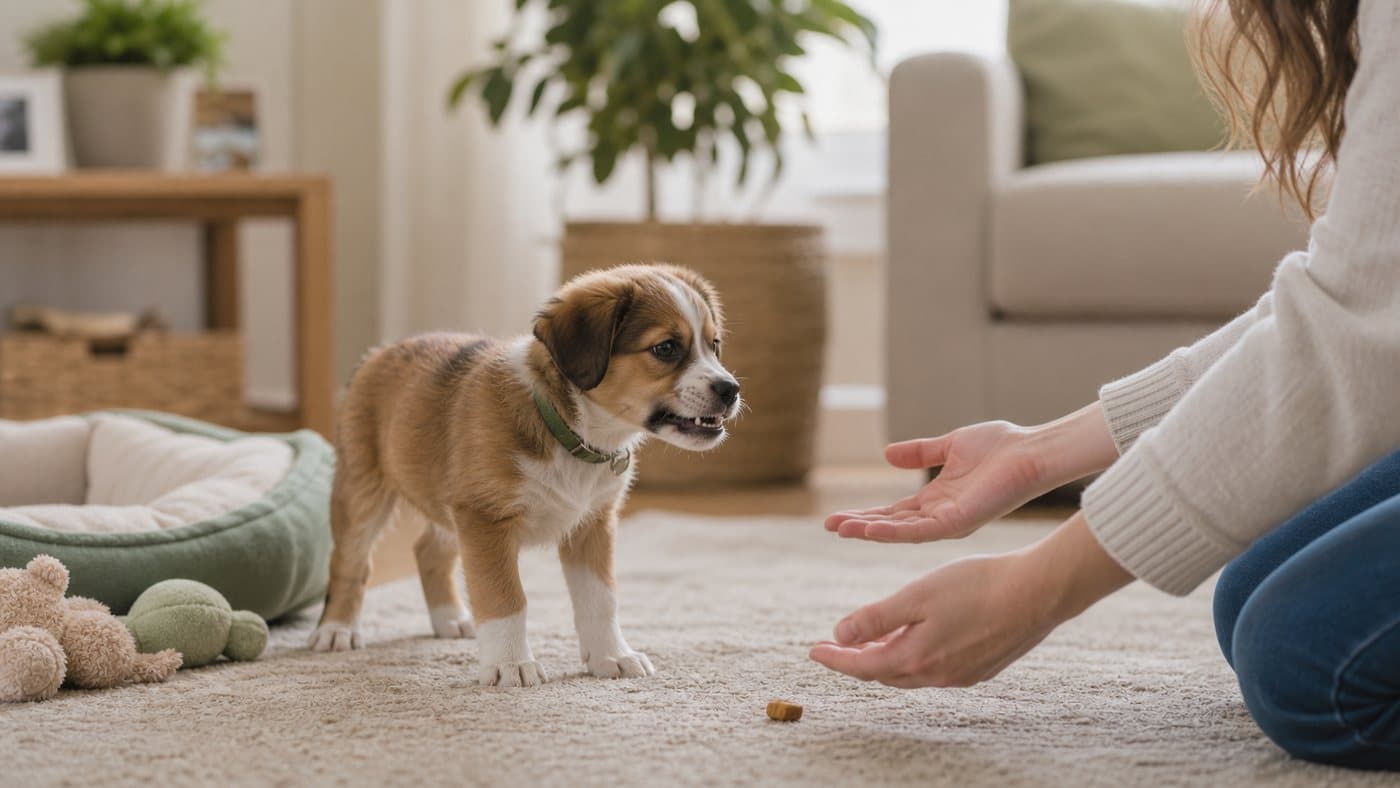
A puppy who growls when picked up is communicating discomfort. They may be scared, sore, startled, or unsure what hands mean. The growl is a warning worth respecting.
Identify the pickup pattern
Does the growl happen every time, only when tired, only when lifted from sleep, or only when children pick the puppy up? Does the puppy stiffen, tuck, lick lips, or try to move away first?
Pain is possible, especially if the puppy yelps, avoids touch, limps, or reacts to one body area.
Do not prove the puppy must tolerate lifting
Do not punish the growl or keep picking the puppy up to prove they must accept it. That can remove warnings and make biting more likely.
Change how hands approach
Reduce unnecessary lifting. Invite the puppy with food instead of grabbing. Practice cooperative handling: touch side, feed; hand under chest, feed; tiny lift, feed; set down before struggle.
Children should not pick up a growling puppy. If growling is sudden, intense, or paired with pain signs, schedule a veterinary check. If it continues after comfort work, involve a qualified force-free trainer.
Growling is communication, not disrespect
A puppy who growls when picked up is saying the handling is uncomfortable, scary, painful, or too sudden. That does not mean the puppy is bad or trying to be in charge. It means the current approach is too hard.
Many puppies are lifted often: into cars, onto grooming tables, away from unsafe objects, up stairs, onto couches, or out of children's arms. If every lift happens quickly and without consent, the puppy may begin warning earlier.
Check the context
Notice when growling happens. Is it only when the puppy is tired? Only when touched under the belly? Only when children pick them up? Only after play? Only when being removed from something fun? Different patterns need different plans.
Health matters. A puppy with stomach discomfort, sore legs, skin irritation, ear pain, or an injury may growl because lifting hurts. If the response is new, sharp, or paired with yelping, limping, hiding, or appetite changes, call your veterinarian.
Teach cooperative lifting
Start with tiny pieces. Touch the side, feed. Slide a hand under the chest, feed. Add a second hand, feed. Lift one inch, feed, and set down. End while the puppy is still comfortable.
Use a cue before lifting, such as "up." The cue should predict a gentle, short lift and a reward. Over time, some puppies will move toward you because the pattern feels safe.
When you must lift in real life, be calm and supportive. Avoid grabbing from above or scooping suddenly from behind.
Reduce unnecessary pickups
Use ramps, steps, recall, hand targets, and management instead of constantly lifting. Teach children that puppies are not toys to carry. If a puppy growls, the child should freeze and call an adult rather than holding tighter.
If the puppy snaps, bites hard, or guards being held by one person, get professional help. Early, respectful handling work can prevent a small warning from becoming a bigger problem.
Build trust outside lifting
Cooperative handling improves faster when the puppy also has choices in daily life. Invite them onto your lap instead of grabbing. Let them step through a harness for food. Reward coming when called before moving them. A puppy who learns that human hands predict good choices is less likely to panic when handling is necessary.
When picking up is unavoidable
Sometimes you must lift a puppy: stairs, car rides, vet tables, unsafe objects, or emergencies. Make those lifts as predictable as possible. Say your lifting cue, support the chest and rear, keep the puppy close to your body, and set them down gently before they struggle.
Avoid swooping from above or surprising the puppy from behind. Those approaches can feel predatory and may make the puppy brace before your hands even arrive.
Children and pickup rules
Children should not pick up a puppy who growls, squirms, mouths, or tries to leave. Even gentle children can squeeze too tightly or hold on when the puppy panics. Give children safer jobs: tossing treats, calling the puppy to an adult, or petting only when the puppy chooses contact.
If the puppy growls mostly around children, change the setup immediately. Growling is early information, and it is much better to respond now than after the puppy learns to snap.
Signs handling is getting safer
Progress may be a puppy who stays loose when a hand touches their side, steps toward you for the lifting cue, or eats calmly after a tiny lift. Do not rush to full carrying if the early steps are still tense.
If growling becomes sharper, if the puppy bites when lifted, or if one body area seems painful, pause the training plan and arrange professional help.
Give the puppy another way to say yes
A simple consent behavior can help. Teach the puppy to put front paws on a low platform, step toward your hands, or rest their chin in your palm for a treat. These behaviors do not mean the puppy must accept anything forever. They give you a way to ask before handling.
If the puppy opts out, respect that when it is safe. The more often your puppy learns that moving away works, the less they need growling to stop routine handling.
Choice does not remove structure. It makes necessary handling clearer, calmer, and easier to predict.