
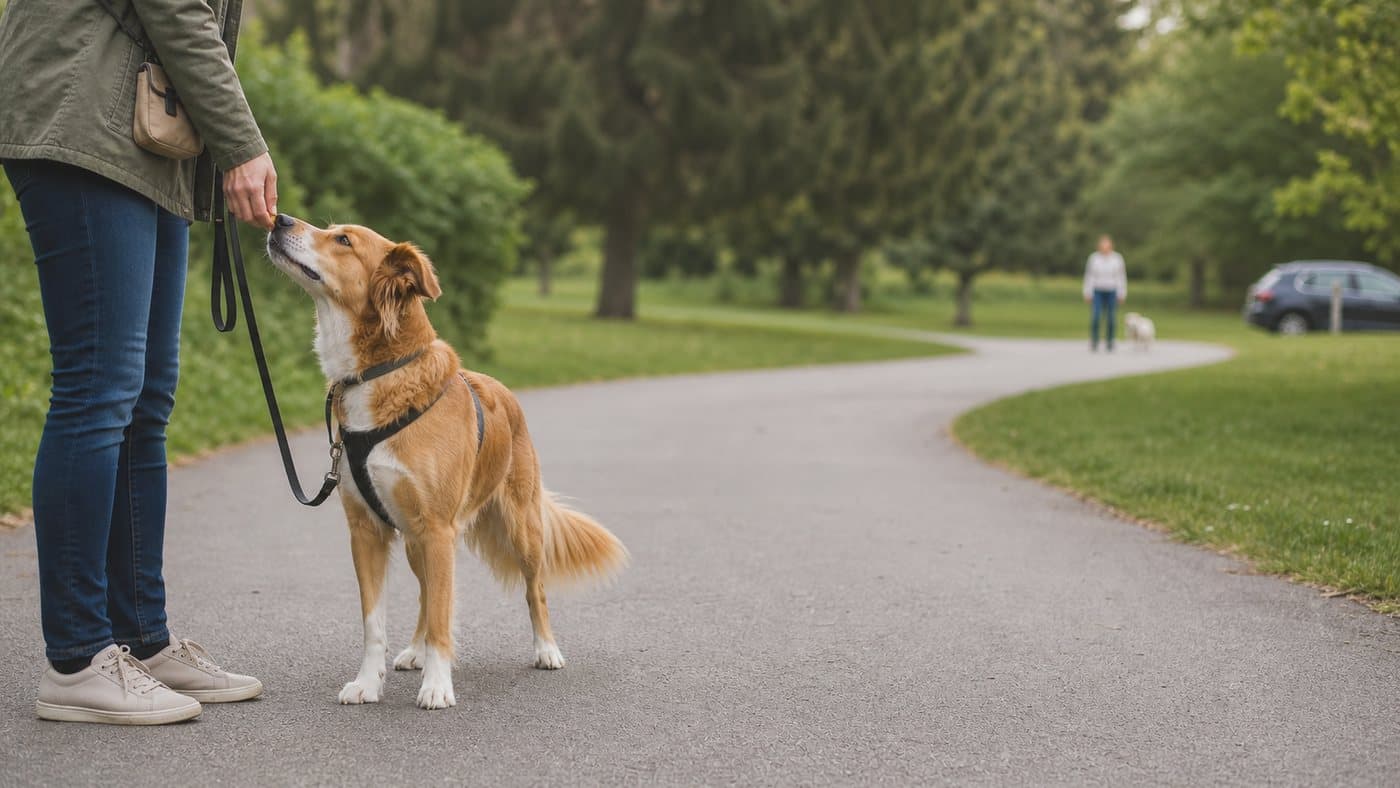
Leash reactivity can make a normal walk feel like a public exam you did not study for. Your dog sees another dog, a bike, a person, or a stroller, and suddenly the leash is tight, the barking starts, and every training cue disappears.
That does not mean your dog is bad. It usually means the environment is too hard at that distance.
The leash removes normal choices
Off leash, dogs can curve, sniff, slow down, retreat, or choose a softer approach. On leash, the options shrink. The dog may feel trapped, frustrated, or physically restrained. If the handler tightens the leash whenever another dog appears, the trigger also predicts pressure.
Reactivity can come from fear, frustration, social conflict, pain, adolescence, lack of exposure, previous bad experiences, or simply too many triggers stacked together.
Why kitchen obedience disappears outside
Many owners say, "He knows sit at home." He probably does. But a quiet kitchen is not the same learning environment as a sidewalk with a dog approaching head-on. Reactivity is not a knowledge problem in that moment. It is an arousal and safety problem.
When a dog is over threshold, food may be ignored, cues may vanish, and the body may lock onto the trigger. That is information. The answer is not louder commands. The answer is more distance and an easier setup.
Early body language before the explosion
Look for the earliest signs: mouth closing, head lifting, ears forward or back, tail rising, weight shift, slowing down, scanning, or suddenly taking food harder. These signs often appear before the bark.
Also watch recovery. A dog who shakes off and sniffs after the trigger passes is processing. A dog who cannot disengage may need a quieter route and shorter walks for now.
Make distance the skill
For the next several walks, make distance the skill. Turn before narrow paths. Cross early. Use parked cars, hedges, and driveways as visual breaks. Reward your dog for noticing a trigger at a distance and then turning back with you.
Use simple pattern games: mark "yes" when your dog sees the trigger, feed, then move away in a curve. You are teaching that triggers predict food and space, not pressure and conflict.
Risk signs that change the plan
If your dog redirects onto you, bites the leash with frantic intensity, has a bite history, or reacts near children, contact a qualified force-free trainer. If reactivity appears suddenly, worsens quickly, or is paired with pain signs, start with a veterinary check.
A walk triage before you leave
Before the leash clips on, decide what kind of walk you are taking. A decompression walk is for sniffing in the easiest place available. It is the right choice after a hard day, a recent reaction, bad weather, or a week with too many unavoidable triggers.
A training walk is short and planned. You choose one location with space, look for one or two easy sightings, then leave while your dog is still successful. The goal is not mileage. The goal is clean reps.
A necessary walk is the practical one: bathroom, building exit, car, or vet visit. On those walks, management matters more than training. Use distance, barriers, food scatters, and quick exits. Do not judge the whole training plan by a necessary walk in a hard environment.
This distinction keeps owners from making every outing a test. Reactive dogs often improve faster when some walks are deliberately easy.
Audit the hard parts of your route
Most reactive walks have predictable danger zones: narrow sidewalks, blind corners, apartment exits, school pickup, dog parks, elevators, and streets where dogs appear behind fences. Mark those places on a simple map.
Then choose routes that give your dog more choices. Wider paths, open parking lots, quiet office parks after hours, and sniff-heavy routes can be more useful than busy neighborhood loops. A walk that looks boring to a person may be exactly the walk a reactive dog needs.
Threshold is the training line, not the sidewalk
Threshold is the point where your dog can still notice a trigger and think. Below threshold, your dog may eat, sniff, glance back, and respond to simple cues. Over threshold, the brain moves into survival or explosion mode.
Your job is to work below threshold more often than above it. That may mean starting so far away that the trigger looks tiny. It may mean rewarding one calm glance and leaving. Small clean repetitions beat dramatic battles.
Mistakes that keep the pattern rehearsed
Common mistakes include walking straight toward triggers, holding a tight leash while asking for calm, waiting until the bark starts before moving, and practicing obedience drills when the dog needs distance.
Instead, make the first behavior easy: see the trigger, eat, turn away, sniff, and recover. Once that pattern is strong, you can gradually practice closer distances with hands-on help if needed.
Another common mistake is measuring bravery by closeness. A dog who passes one foot from another dog while stiff, silent, and unable to eat is not necessarily improving. They may be enduring. Better practice usually looks less impressive: more distance, softer body, food taken normally, and a clean turn away.
A better route for one week
For one week, pick routes based on space, not distance covered. A ten-minute sniff walk in a quiet parking lot may be more useful than a thirty-minute neighborhood loop full of unavoidable dogs. Use the walk to collect clean repetitions: notice a trigger, eat, move away, recover.
If you live in a dense area, choose time windows with fewer dogs, use building exits carefully, and wait inside if the hallway is busy. The point is not to hide from the world. The point is to stop practicing the same explosion every day.
Build a recovery routine
Reactive dogs need a way to come down after a trigger. Pick a simple routine and practice it when nothing is happening: turn away, scatter food in grass, sniff for ten seconds, then walk in a quiet direction. This gives your dog a known path out of arousal.
Use the recovery routine after easy sightings too, not only explosions. That way it becomes part of the walk rather than an emergency tool. A dog who can recover repeatedly is building resilience.
What to do after a bad reaction
Do not keep marching into more triggers to "end on a good note." If your dog has already exploded, the nervous system is loaded. Move to a quieter area, scatter food if they can eat, or go home and try an easier route next time.
Take one note: distance, trigger type, and recovery time. That is enough. You do not need to replay the whole walk emotionally. You need data for the next setup.
Walks are improving when recovery gets shorter
Progress is often quieter than owners expect. Your dog sees a dog and takes food. Your dog barks once and recovers in five seconds. Your dog can turn away before the leash goes tight. These small changes mean the walk is becoming more predictable and less like a public emergency.
That is the foundation for harder sidewalk work later.
Without that foundation, closer practice usually becomes another rehearsal of the same reaction. A good leash-reactivity plan should make walks less dramatic first. Precision can come later.