
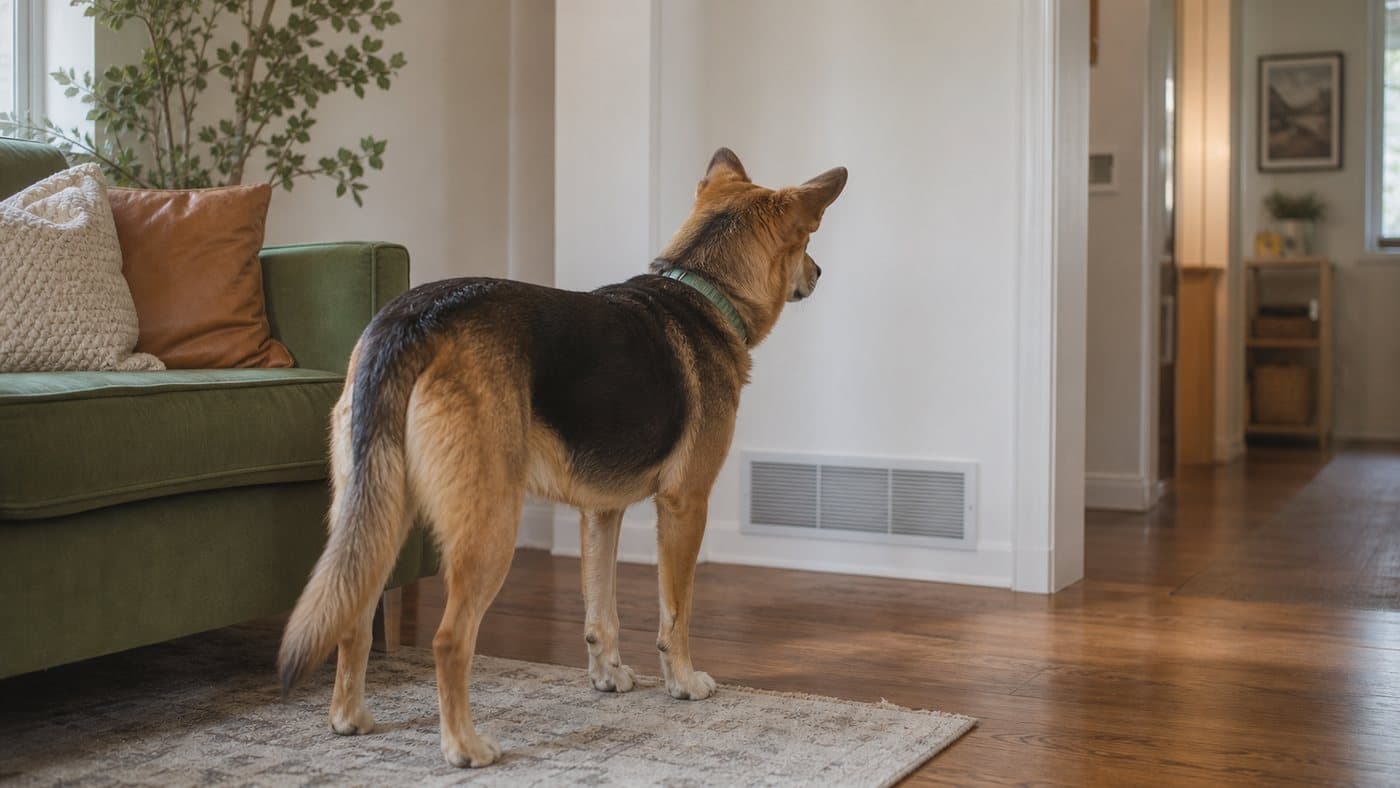
When a dog barks at "nothing," the trigger is often outside human awareness. Dogs hear, smell, and notice movement differently than we do. A car door down the street, a neighbor in the hallway, a distant dog, a reflection, wildlife under the deck, or a routine that predicts excitement can all be enough.
The barking is real. The trigger is just not obvious yet.
Start with the hidden trigger list
Alert barking happens when a dog notices a change and announces it. Window barking often follows movement outside. Night barking is common in quieter rooms where small sounds stand out. Some dogs bark at reflections, shadows, appliance noises, pipes, or phone sounds.
Stress can lower the barking threshold. A dog who had a hard walk, visitors, poor sleep, or a scary noise earlier in the day may bark at smaller triggers later.
For senior dogs, sudden night barking or barking at empty spaces also raises health questions: pain, sensory decline, cognitive changes, or confusion.
Body language separates alerting from worry
A curious alert dog often has forward ears, a lifted head, and quick movement toward the sound. A worried dog often barks with weight shifted back, a closed mouth, tucked tail, lip licking, or repeated scanning. A frustrated dog often barks and bounces between you and the window.
The recovery matters. Can your dog sniff, take food, and settle after the sound? Or do they stay on patrol?
Do not add more noise to the noise
Do not assume your dog is being dramatic. Do not yell over the barking. Yelling can sound like joining in, and it often adds arousal. Also avoid startling devices or punishment collars. They may stop noise while increasing anxiety about the environment.
Run a three-day pattern check
Keep a three-day barking log. Record time, location, direction your dog faces, weather, hallway sounds, outside movement, and what happened right before the bark. Patterns usually appear faster than expected.
Try changing the environment. Close the blinds, add white noise, move your dog away from the front window, or block access during predictable delivery times. If the barking drops, you found part of the trigger.
Teach a reset away from the trigger
Teach a simple reset. When your dog barks once or twice, calmly say "thank you," toss a treat away from the trigger, and guide them to a different activity. The treat is not rewarding endless barking; it is interrupting the patrol loop and reinforcing movement away.
If barking is sudden, happens at night in a senior dog, or comes with disorientation, pain signs, or appetite changes, schedule a veterinary check.
Test one theory at a time
Once the log shows a pattern, test the simplest explanation first. If barking clusters near the front window, block that view for two days. If it happens near the apartment door, add hallway sound masking. If it happens after evening walks, make the post-walk routine quieter and more predictable.
Change only one thing at a time. If the barking drops, keep that setup for a week before adding a new layer. If nothing changes, return the room to normal and test the next likely trigger.
Use a mystery-bark decision tree
If the bark points toward a window or fence, assume your dog sees movement or expects movement. Start with visual management: window film, curtains, a gate, or changing where the dog rests during busy hours.
If the bark points toward a door, wall, ceiling, or hallway, think sound and scent first. Add steady noise, check building patterns, and note whether it happens around elevators, plumbing, footsteps, neighbors, or delivery times.
If the bark happens mostly at night, treat it differently from daytime alerting. Look at outdoor animals, low light, bathroom needs, pain, sleep disruption, and senior-dog changes. A sudden night pattern deserves more health attention than a long-standing afternoon window habit.
If the bark comes with scanning, tucked posture, refusal to leave, or slow recovery, lower the pressure before training. If the dog barks once, checks in, and returns to normal, you may be dealing with alerting that can be shaped into a simple notice-and-reset routine.
What the bark sounds like adds context
A sharp alert bark with quick pauses often means your dog is checking for a response. Repetitive barking while scanning suggests uncertainty. Barking with backward weight, tucked posture, or refusal to leave the area points toward fear. Barking with bouncing and running back to you points more toward excitement or demand for your participation.
Sound alone is not enough, but it becomes useful when paired with posture and recovery.
A quick room-by-room check
At the front window, look for movement, delivery patterns, dogs passing, school traffic, and reflections.
In hallways or apartments, listen for doors, footsteps, elevators, carts, plumbing, and voices that are louder to your dog than to you.
At night, check outdoor animals, distant dogs, appliances cycling on, pain signs, and whether your dog startles more easily in low light.
A calmer home setup
Dogs who patrol all day often need fewer visual responsibilities. Use window film, curtains, baby gates, or furniture changes to remove the lookout station during busy hours. Add predictable enrichment before known barking windows, such as delivery times or evening hallway traffic.
When your dog notices a sound and looks at you, reward that check-in. The new pattern is notice, report, and disengage.
Use technology carefully
A camera can help you find patterns when barking happens in another room or while you are away. You might see your dog orient to the same wall, window, vent, or hallway before each bark. You might also notice that barking follows a delivery, neighbor movement, or outdoor animal route.
Do not use the camera to scold through a speaker. A disembodied voice can confuse or worry some dogs. Use recordings for observation first, then change the environment or routine.
Common wrong turns
One wrong turn is arguing with the bark from across the room. That usually makes the event feel bigger. Another is assuming the dog "knows nothing is there" because you cannot see it. The dog may be responding to sound, scent, vibration, or a pattern you have not noticed yet.
The third wrong turn is changing everything at once: blinds, white noise, new bedtime, extra exercise, and a new cue on the same day. If barking improves, you will not know what helped. If it gets worse, you will not know what overwhelmed the dog. Test one clean change at a time.
When "nothing" becomes a vet question
If mystery barking is sudden, mostly at night, or appears with confusion, staring, pacing, house soiling, appetite changes, or pain signs, involve your veterinarian. Senior dogs may bark because of sensory changes, discomfort, or cognitive changes. Younger dogs can also bark more when they are in pain or stressed.
Training can help many barking patterns, but medical causes should not be trained over.
Mystery barking is improving when the pattern gets visible
Progress looks like a shorter bark, a faster check-in, or a dog who leaves the window after one cue. It also looks like fewer barking episodes after you close blinds or add white noise. That is not cheating. It means you identified part of the trigger and made the environment easier.
Good observation turns mystery barking into a workable pattern. Once the pattern is visible, you can change the setup instead of arguing with the bark.