
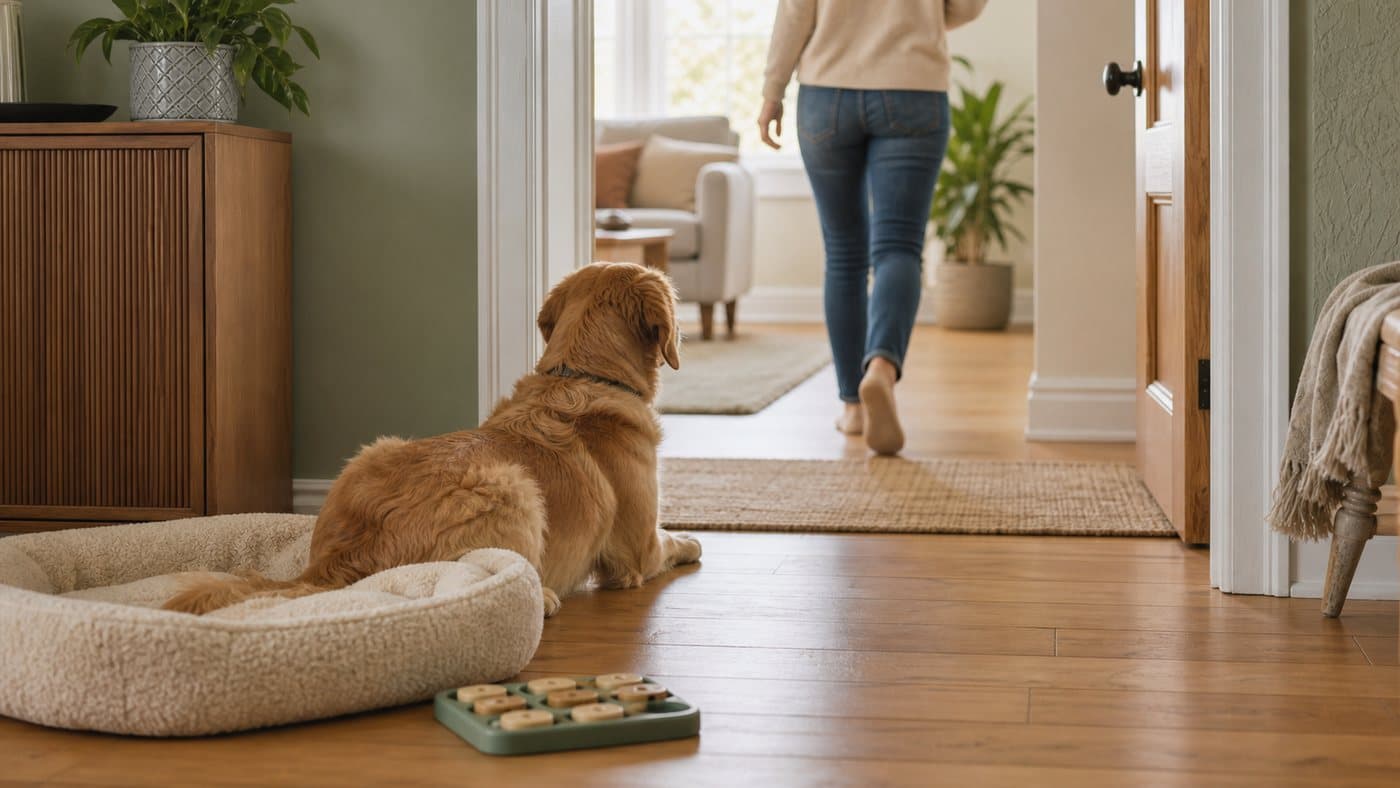
Many dogs follow their people from room to room. Sometimes it is ordinary social behavior. Sometimes it is a habit that has been rewarded. Sometimes it is the visible edge of separation-related distress.
The difference is not whether your dog loves you. The difference is whether your dog can relax when access to you changes.
Flexible following is usually normal
Normal following looks flexible. Your dog trails you into the kitchen, sniffs around, maybe hopes for a dropped crumb, then settles when nothing interesting happens. They can nap in another room. They can stay behind a baby gate with a chew. If you close a door briefly, they may notice but recover.
This kind of shadowing is common in companion dogs. People are interesting. People open doors, deliver meals, start walks, and create routines.
Clinginess that changes the picture
Following becomes more concerning when your dog cannot disengage. You may see pacing, staring, whining, pawing, panting when the room is cool, or jumping up whenever you shift in your chair. Some dogs sleep lightly so they can track every movement.
Watch pre-departure cues. Does your dog change when you pick up keys, put on shoes, shower, pack a bag, or move toward the front door? If the following becomes intense only around departure routines, you may be seeing anxiety about being left.
Sudden clinginess also matters. A dog who becomes unusually attached overnight may be responding to pain, illness, sensory changes, household stress, a move, a new baby, schedule changes, or aging.
Do not jump to one label
Do not assume your dog is manipulative or trying to control you. Close following often comes from reinforcement history, uncertainty, or worry. Also do not assume every shadow dog has separation anxiety. A dog can prefer your company and still be comfortable alone.
Check what happens after you leave
Set up a camera and watch what happens after you leave for one minute. A dog with normal attachment may wait by the door briefly and settle. A worried dog may pace, vocalize, scratch, drool, refuse food, or move between exit points.
Track whether your dog can relax when you are visible but unavailable. Try reading quietly while your dog has a chew behind a gate. Can they work on the chew, or do they stare at you the whole time?
Practice access changes while you are home
Build tiny independence reps while you are home. Give your dog a safe chew or food puzzle, step behind a gate for a few seconds, return before distress, and keep the moment boring. You are teaching "access changes are safe."
If the following is sudden, paired with appetite changes, irritability, limping, house soiling, confusion, or sleep disruption, schedule a veterinary check. If your dog panics when left alone, work with a separation-anxiety specialist.
A green, yellow, red read
Green following is flexible. Your dog follows, checks what you are doing, and can drift away or settle when nothing happens.
Yellow following is sticky. Your dog watches most movements, struggles behind barriers, or ignores chews when you are visible but unavailable. That pattern deserves gentle independence practice and better observation.
Red following is distress. Your dog panics during absences, scratches exits, drools, vocalizes repeatedly, refuses food, or suddenly becomes clingy with physical changes. That is the point to involve a veterinarian or separation-anxiety specialist instead of simply practicing longer absences.
Choose the right branch before training
If the following is flexible and mostly happens around food, walks, or interesting household activity, focus on routine and reinforcement. Pay calm resting before the dog shadows you, and make some of your movements uneventful.
If the following is sticky but your dog can still eat, settle, and recover behind a gate, use tiny access-change practice. Keep the goal small: seconds of relaxed separation, not a full afternoon alone.
If the following appeared suddenly, changed with age, or comes with pain, appetite, sleep, bathroom, or confusion changes, start with health. If the dog panics when you actually leave, start with separation support. The order matters because independence exercises are only fair when the dog is physically comfortable and emotionally under threshold.
The room-by-room test
For three ordinary days, notice which kind of following you are seeing. Does your dog follow because you stood up, because you moved toward the door, because food might happen, or because they cannot relax unless they are touching you?
Try sitting in one room while your dog has a safe chew in another room behind a gate. Do not command them to stay. Just watch whether the chew can compete with your movement. A relaxed dog may check on you and return to the chew. A worried dog may ignore the chew, stare, whine, pant, or paw at the barrier.
Building independence without pushing too hard
Start with separations so small they look almost silly. Step over a gate, drop a treat, step back. Close a bathroom door for two seconds, then return. Walk to the mailbox while your dog eats a scatter, then come back before worry builds.
The repetition teaches predictability. Your dog learns that tiny access changes are safe and temporary. If you wait until the dog is barking or scratching, the exercise is already too hard.
When clinginess is a medical clue
Sudden clinginess deserves special care in senior dogs, newly adopted dogs, and dogs with recent medication or routine changes. Pain can make a dog seek contact. Nausea can make a dog restless. Hearing or vision changes can make normal household movement feel less predictable.
If your dog is suddenly shadowing you and also sleeping poorly, panting, hesitating on stairs, hiding, guarding, or acting irritable, treat the behavior as a possible health signal first and a training project second.
Make your movements less important
Some dogs follow because every human movement predicts something exciting. You stand up and food appears. You touch the leash and a walk starts. You open a drawer and a chew comes out. That pattern is normal, but it can make a dog hyper-alert to every shift in your body.
You can lower the drama by making some movements meaningless. Stand up, stretch, and sit back down. Pick up your keys, place them on the counter, and keep reading. Walk to the door, touch the handle, and return to the couch. Keep these repetitions casual and below your dog's worry point.
This is not about tricking your dog. It is about teaching that not every cue deserves a full-body alarm. If your dog becomes more anxious during these exercises, make them smaller and easier.
What to stop accidentally rewarding
Following often gets paid without anyone noticing. The dog follows you to the kitchen and gets a crumb. They follow you to the door and get a walk. They paw at you while you work and get touch or conversation. None of that is wrong, but it can make shadowing more persistent.
Add predictable moments when attention, food, and walks happen without your dog needing to track every movement. Feed from a mat, start walks from a calm cue, and reward your dog for resting away from your feet. The goal is not less connection. It is less vigilance.
A better daily goal
The goal is not to stop your dog from liking your company. The goal is a dog who can choose rest when you are nearby, behind a door, or briefly out of sight. A healthy version of independence looks ordinary: your dog finishes a chew while you leave the room, sleeps through small household movement, or notices your keys without panicking.
Reward calm separation moments when they happen naturally. If your dog is resting in another room, do not call them over just because it feels sweet. Let that independence continue. Quietly protecting those small successes can be more useful than another formal training session.