
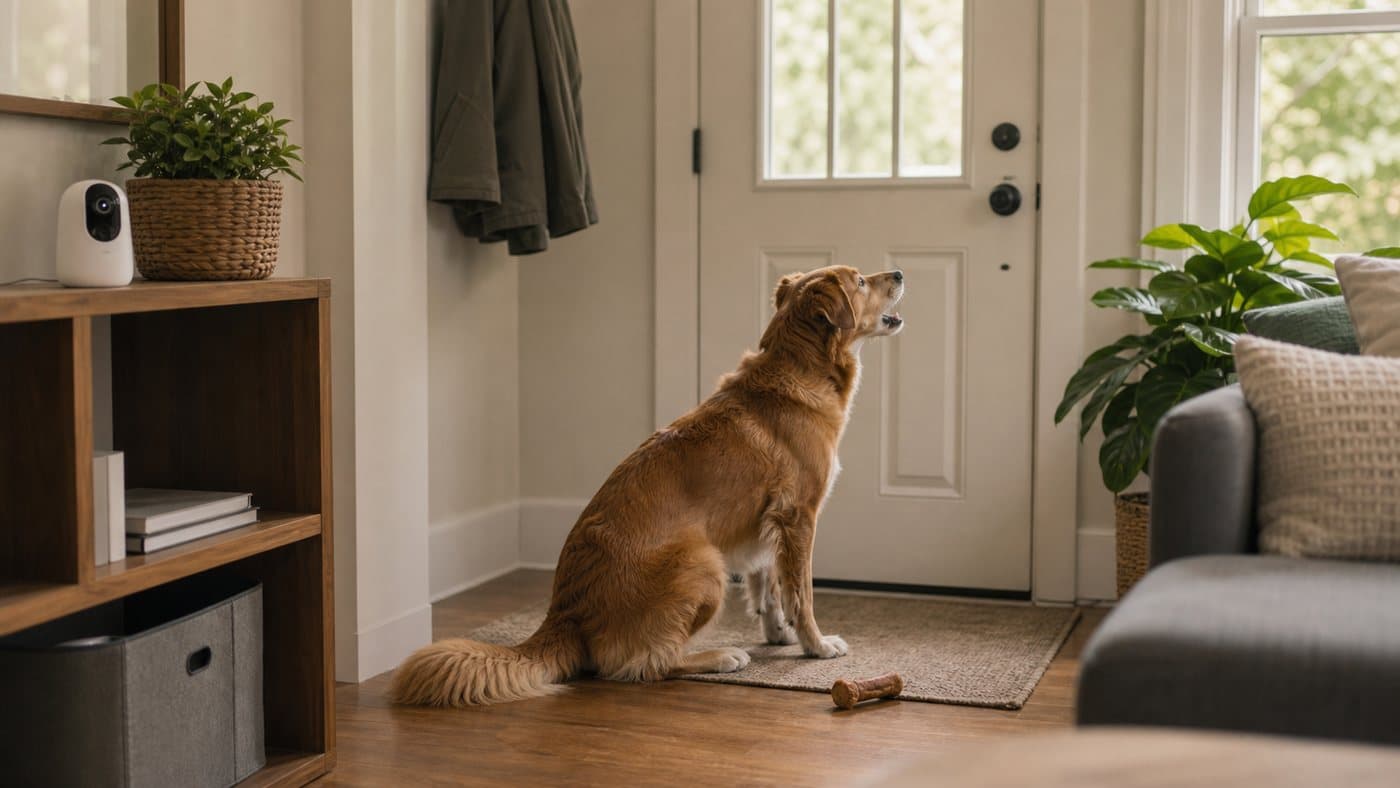
If your dog barks when left alone, do not guess from the damage or the neighbor note. Use video. The timing, body language, and recovery pattern tell you whether the barking looks like boredom, alerting, frustration, or separation-related distress.
Timing changes the meaning
Barking that starts immediately after you leave may point to panic, frustration, or distress around departure cues. Barking that starts after a hallway noise may be alerting. Barking that starts after hours of quiet may be boredom or unmet needs.
A dog who barks while pacing, drooling, scratching exits, or refusing food is in a different state from a dog who barks briefly at a sound and settles.
Record the right moments
Record the first 10 minutes and one longer absence. Note whether your dog eats, rests, patrols windows, scratches the door, howls, or barks in response to outside sound. Track whether the behavior happens only in the crate or also when loose in a safe room.
Make the absence easier first
Meet normal needs first: bathroom, food, safe rest, and appropriate enrichment. Then reduce sound and visual triggers with white noise, curtains, or a calmer room.
If the video shows panic, do not solve it with bark collars or punishment. Start with a safe absence baseline and consider a veterinarian or separation-anxiety specialist. If the barking is mild alerting, teach a calmer room routine and reduce access to trigger windows.
What the footage tells you
Barking alone has different meanings. A dog who barks three times at a hallway sound and then naps may need environmental management. A dog who barks continuously at the door, paces, pants, drools, scratches, or refuses food may be experiencing separation-related distress.
Video prevents the most common mistake: treating panic like misbehavior. Set up a phone or camera for a normal departure. Watch the first minute, the first ten minutes, and a later point in the absence. Note the first sign of stress, not only the loudest sign.
Look at timing. Distress that begins before you leave, or within seconds after the door closes, is more concerning than barking that starts when a delivery truck arrives twenty minutes later.
Reduce triggers while you investigate
Make the absence easier before adding training. Close blinds, use white noise, choose a room away from street noise, and remove unsafe objects. For some dogs, a crate increases panic. For others, a familiar gated room is easier. The safest setup is the one where your dog can settle without injuring themselves.
Avoid leaving long-lasting chews if your dog is frantic. A distressed dog may gulp, break teeth, or ignore the chew completely. Food puzzles are useful only when the dog is calm enough to use them.
Build from the calm baseline
If the barking looks like separation distress, find the longest absence your dog can handle without escalating. It may be a few seconds. Practice departures below that point, return calmly, and build slowly. The goal is not to surprise the dog into silence. The goal is to change how departures feel.
For alert barking, practice short absences after exercise and bathroom needs are met. Reward calm room routines while you are home, then step out briefly.
Contact a veterinarian or separation-anxiety specialist if barking is intense, paired with escape attempts, or interfering with necessary daily life.
Boredom, alerting, or panic?
A bored dog may bark after a long quiet stretch, then look for something to do. An alerting dog may bark at a hallway sound, passing person, mail truck, or neighbor dog, then settle when the trigger is gone. A panicking dog often begins early, stays near exits, ignores food, paces, howls, drools, or scratches.
These patterns can overlap, which is why video matters. Do not decide from the neighbor complaint alone. Watch the body, not only the volume.
Apartment and neighbor pressure
If you share walls, you may need a temporary management plan while you investigate. Leave during quieter building hours, use white noise, choose an interior room, cover windows, and tell neighbors you are actively working on the issue if that is safe to do.
Avoid quick fixes that punish barking while leaving panic untreated. Bark collars can make absence feel more frightening and may hide the symptom without improving welfare. A quieter dog is not necessarily a calmer dog.
What to record for help
Save a few short video clips: the first minute after departure, the first time barking starts, and a later point in the absence. Note whether the dog eats, where they spend time, and what happens right before barking. These clips help a veterinarian or separation anxiety professional separate distress, confinement problems, and environmental triggers.
If the barking is mild
Mild barking still deserves a plan before it becomes a habit. Practice short, easy absences after your dog has had a bathroom break and a chance to decompress. Choose the calmest room, leave a safe rest area, and return before barking builds. Reward quiet settling when you are home so the dog already knows what to do in that space.
If your dog barks once or twice at a sound and returns to bed, focus on sound and window management. If each absence becomes longer, louder, or more frantic, shift toward a separation-distress plan sooner.
What not to measure
Do not measure success only by whether the neighbors hear barking. A dog can be silent and still panicking, especially if punishment has been used. Measure welfare: relaxed body, ability to eat, ability to rest, less exit focus, and faster recovery. Quiet matters, but calm matters more.