
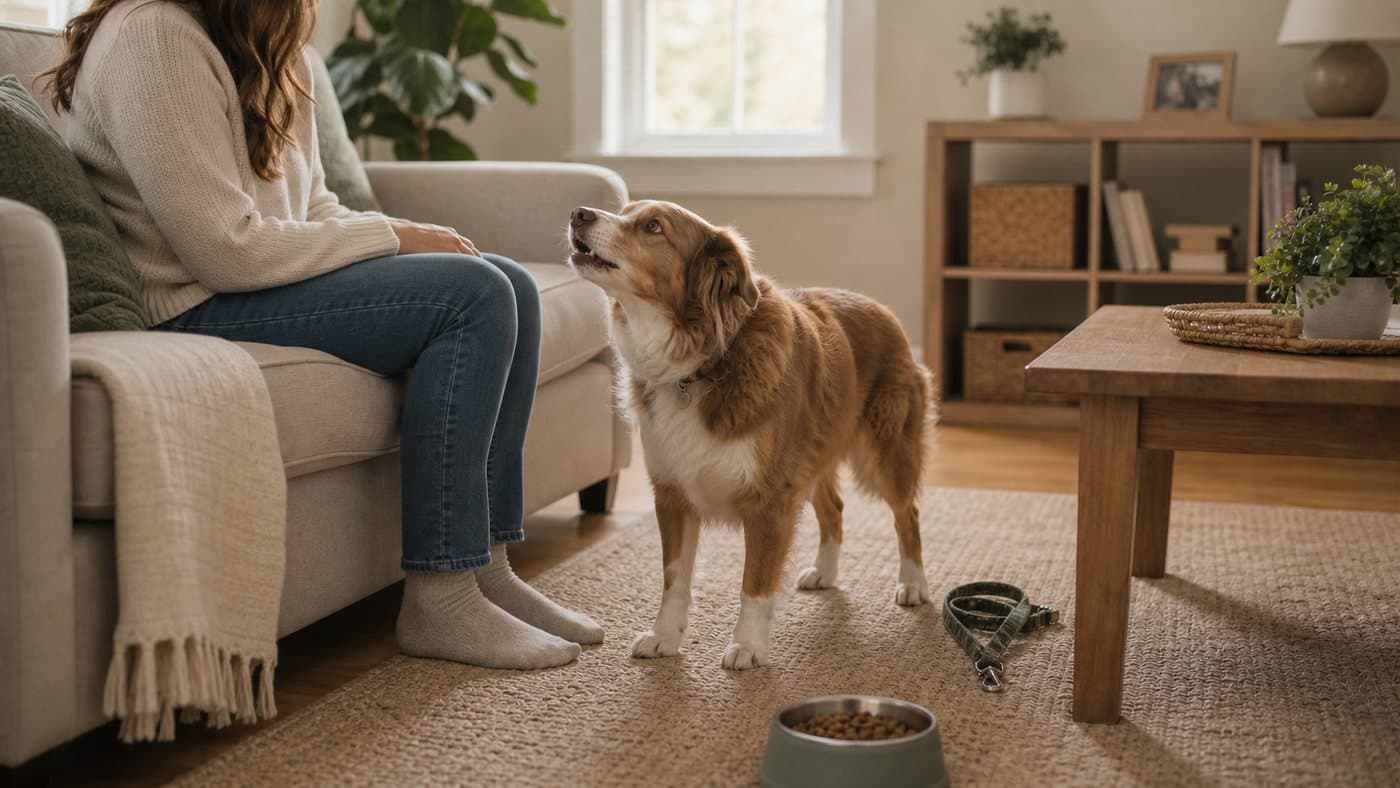
Whining is one of those behaviors that means very little until you look at the context. A dog may whine because they are excited, worried, frustrated, uncomfortable, asking for help, anticipating a walk, or repeating a sound that has worked before.
Before you train it, translate it.
Translate it by timing, body, and relief
Anticipation whining often appears before meals, walks, car rides, or greetings. The dog may be bright, bouncy, and focused on a predictable event.
Frustration whining appears when the dog can see what they want but cannot reach it: another dog, a toy under the couch, a person behind a gate, or the front door. The body may be forward and restless.
Anxiety whining can come with pacing, panting, scanning, clinginess, tucked posture, or inability to settle. It may appear during crate time, storms, departures, vet visits, or new environments.
Pain-related whining may be sudden, happen during movement or touch, appear in a senior dog, or come with appetite changes, limping, restlessness, or unusual irritability.
The third clue is what brings relief. A dog who settles after a bathroom break needed a bathroom break. A dog who keeps pacing after attention probably needs a different answer.
Do not call it attention seeking too early
Do not assume whining is always attention seeking. Even if attention has reinforced it, the dog may still have a real need underneath. Also do not ignore sudden or persistent whining in the name of training. Medical discomfort should be ruled out.
Avoid yelling or startling. That can add stress and make the dog less likely to communicate early.
Watch what actually changes it
Track when the whining starts, what stops it, and what your dog does with their body. Does food help? Does distance help? Does movement help? Does the dog settle after a need is met, or continue to seem restless?
If whining happens in the crate, record it. Is the dog objecting briefly and then resting, or pacing, drooling, pawing, and escalating?
Teach the next repetition, not the noisy one
Respond to the need, then teach a calmer pattern. If the dog whines before meals, ask for a simple station behavior before you start food prep. If the dog whines from frustration at a window, block the view and reinforce settling elsewhere. If the dog whines from anxiety, lower the difficulty and build comfort gradually.
If whining is sudden, intense, paired with pain signs, or appears in a senior dog with confusion or restlessness, schedule a veterinary check. If it comes with panic during absences, repeated escape attempts, guarding, or escalating distress, involve a qualified behavior professional instead of trying to push through it alone.
Make a whining translation log
For one week, write down what happened in the 30 seconds before the whining and what stopped it. Did you stand up? Pick up the leash? Close a gate? Sit on the couch? Start cooking? Leave the room?
Then label the likely function: anticipation, frustration, worry, discomfort, learned attention, or unknown. You do not need to be perfect. The act of logging usually reveals patterns that are invisible in the moment.
Respond without reinforcing panic
If whining signals a real need, meet the need calmly. If your dog needs to go out, go out without a big emotional production. If your dog is frustrated by a toy under furniture, help once and then change storage so it does not keep happening.
For attention whining, reinforce quiet before the whine starts. Ask for a mat settle, reward stillness, and give attention when your dog is not pushing the button. Waiting for whining and then scolding still gives the behavior a spotlight.
When whining means lower the difficulty
If your dog whines in the crate, during separation, in the car, or at the vet, do not assume they need to toughen up. The setup may be too hard. Shorter sessions, more distance, better conditioning, and slower exposure can change the emotional response.
Sudden whining, especially in a dog who is usually quiet, is a reason to check comfort, pain, digestion, and mobility.
Whining before predictable events
If whining happens before meals, walks, or car rides, the dog may be anticipating a known routine. You do not have to remove the routine. Make the start calmer. Ask for a station behavior before food prep, clip the leash only after a quiet pause, or reward calm waiting before opening the car door.
The goal is not to punish excitement. It is to teach that calm behavior starts the next step faster than escalating noise.
Whining in crates or behind gates
Barrier whining needs context. A dog who whines briefly and then settles may be learning patience. A dog who escalates, paws, drools, pants, or refuses food may be distressed. Record video instead of guessing.
If the barrier is too hard, lower the difficulty. Practice with the door open, then a brief close, then a few seconds while you remain nearby. Do not jump from easy practice to a long absence and expect the dog to generalize.
Give the dog a clearer request
Some whining decreases when the dog has a better way to ask. Teach a bell for bathroom needs, a mat for attention, a hand target for help, or a toy retrieve for play. Reward the clear request before whining starts.
Clear communication reduces frustration for both sides. It also helps you notice when whining is not about training at all, but about discomfort or anxiety.
The whining routine is improving when
Progress is not a dog who never vocalizes. It is a dog who can settle faster, use a clearer request, and recover after the need is met. If whining becomes more frantic, more frequent, or appears with physical changes, stop treating it as a manners issue and look for stress or health clues.