
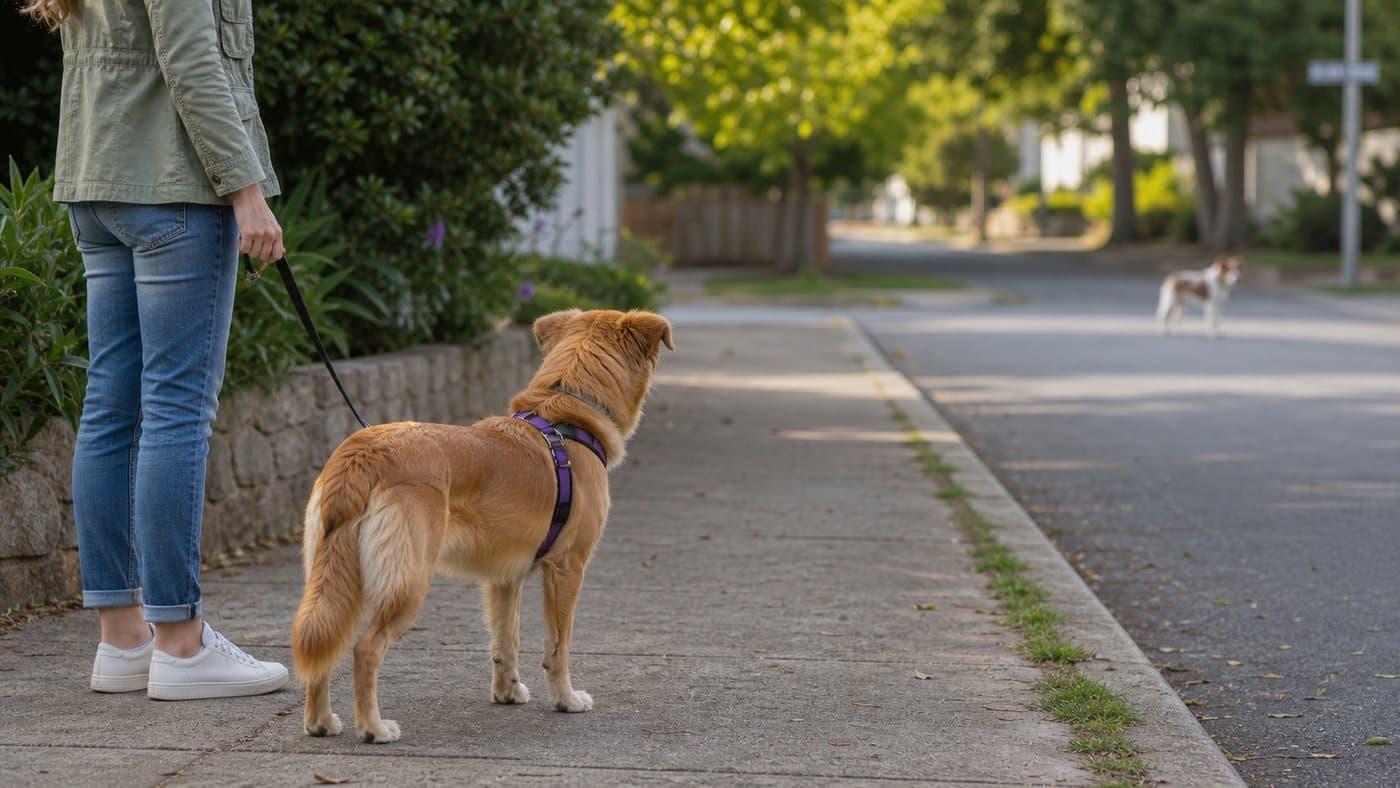
A dog who freezes when seeing another dog is not necessarily being stubborn. Freezing is often a stress signal. It can come before barking, lunging, hiding, or trying to flee.
The freeze means your dog is processing and may be close to threshold.
Read the freeze before moving
Watch the whole body. Does the mouth close? Does the tail rise or tuck? Are the eyes hard? Is your dog leaning forward or backward? Can they take food? Can they turn away if you create distance?
The direction matters. A dog frozen forward may be conflicted or frustrated. A dog frozen backward may be worried. Either dog needs space before training can happen.
Do not pull through a freeze
Do not drag the dog toward or away from the trigger. Leash pressure can add panic. Do not ask for repeated sits if your dog cannot think. Give distance first.
Move before the feet lock
When your dog freezes, say a calm cue and move in a curve away from the other dog. Feed after your dog can blink, sniff, or turn. On future walks, act earlier: reward the first look before the freeze.
If freezing escalates to snapping, redirected bites, or intense lunging, get help from a qualified force-free trainer.
Freezing is not calmness
A frozen dog can look "well behaved" from a distance, but stillness may be a stress signal. The dog may be gathering information, deciding whether to flee, or feeling stuck because the leash limits options. If the body is stiff, mouth closed, weight shifted, and eyes locked on the other dog, do not treat the freeze as obedience.
Some dogs freeze before lunging. Others freeze because they are trying not to make the situation worse. In both cases, the useful response is to create space before the dog tips into a bigger reaction.
Notice the moment before the freeze
The trainable moment often comes earlier than owners expect. It may be the first ear flick, first stare, slowing step, or raised head. Mark that moment and move away before the feet stop. If you wait until your dog is planted, learning becomes harder.
Keep a note of distance. How far away was the other dog when your dog first noticed? Was the dog moving toward you, standing still, barking, or appearing around a corner? Triggers that move directly toward your dog are usually harder than dogs moving parallel at a distance.
Helpful walk patterns
Practice U-turns and curved exits when no dog is present. Say "this way," turn your shoulders, feed as your dog follows, then continue. When a real trigger appears, the movement is already familiar.
Use sniffing as a reset. After you create distance, scatter a few treats in grass or leaves. Sniffing can lower arousal and gives your dog something to do besides stare.
Avoid narrow routes during training. Choose open areas where you can change direction without dragging your dog. If your neighborhood is crowded, shorter decompression walks in quieter locations may be more useful than pushing through busy sidewalks.
When freezing needs professional help
Get help if your dog freezes and then explodes, redirects onto the leash or handler, has a bite history, or cannot recover after the other dog leaves. A force-free trainer can help you build controlled setups so your dog gets practice at a distance where thinking is still possible.
What freezing can look like before barking
Many owners notice the bark or lunge because it is loud. The freeze is quieter, but it is often the earlier clue. Your dog may stop mid-step, close their mouth, lift one paw, lean forward, hold their breath, or stare without blinking. Some dogs look almost statue-like. Others slow down so much that the walk feels stuck.
If you see this pattern, assume your dog is working hard. Do not wait to see whether they "snap out of it." Create distance while they are still able to move. The earlier you act, the less dramatic the behavior has to become.
A plan for the next walk
Choose a route with space before you need it. Wide streets, parking lots, school fields after hours, and quiet trails give you options. Before any dogs appear, practice three easy skills: turning with you, eating from your hand, and sniffing after a treat scatter. Those are the tools you will use when a real dog appears.
When your dog notices another dog, mark the look with a calm word, then move in a curve. Feed after the first step away, not while you are pulling against a frozen body. If your dog cannot move, create space yourself by stepping sideways, loosening leash pressure if safe, and giving them a moment to blink or sniff.
Do not make every walk a test
Reactive and fearful dogs need decompression too. If your dog froze several times yesterday, choose an easier walk today. Sniffing in a quiet place, practicing in the driveway, or taking a shorter route can build confidence better than another difficult sidewalk session.
Progress means your dog notices dogs earlier, recovers faster, and can choose movement instead of getting stuck. It does not mean they ignore every dog immediately.
A simple distance diary
For a week, track three numbers: how far away the other dog was, whether your dog could eat, and how long recovery took. You do not need perfect measurements. "Across the street," "half a block," and "same sidewalk" are enough to see a pattern.
If your dog can eat at half a block but freezes on the same sidewalk, your training distance is clear. Start at the easier distance and protect it. If recovery takes several minutes, end the walk or move to a quieter area instead of looking for another practice repetition. The diary helps you train the dog you actually have that week, not the dog you wish would be fine today.