
Dogs jump on guests because arrivals are exciting and jumping often works. The guest looks at the dog, talks to the dog, touches the dog, pushes the dog, or laughs. Even "No, get down" can be part of the reward if the dog wanted interaction.
The solution is not hoping your dog becomes calm after the doorbell rings. The solution is building a door routine before the guest enters.
Jumping keeps working because people respond
Jumping gives dogs access to faces, hands, scent, and attention. It also releases energy. If the dog sometimes gets petted while jumping and sometimes gets scolded, the behavior can become even more persistent because it still occasionally pays.
Young dogs and social dogs are especially likely to jump when arousal rises faster than their skills.
Find the first trigger and the payoff
Notice the first trigger. Is it the doorbell, knocking, voices outside, your body language, or the guest stepping inside? Many dogs start escalating before the door opens.
Watch the body. Loose wiggly jumping is usually social arousal. Hard barking, blocking, growling, retreating, or snapping changes the plan and may involve fear or guarding.
Do not add conflict to the greeting
Kneeing the dog, yelling, leash popping, or grabbing the collar may add conflict to an already intense moment. For some dogs, physical correction increases arousal. For worried dogs, it makes guests predict bad things.
Do not rely on guests to train your dog. Guests are inconsistent. Set up the environment so your dog can succeed before human chaos enters.
A practical door plan
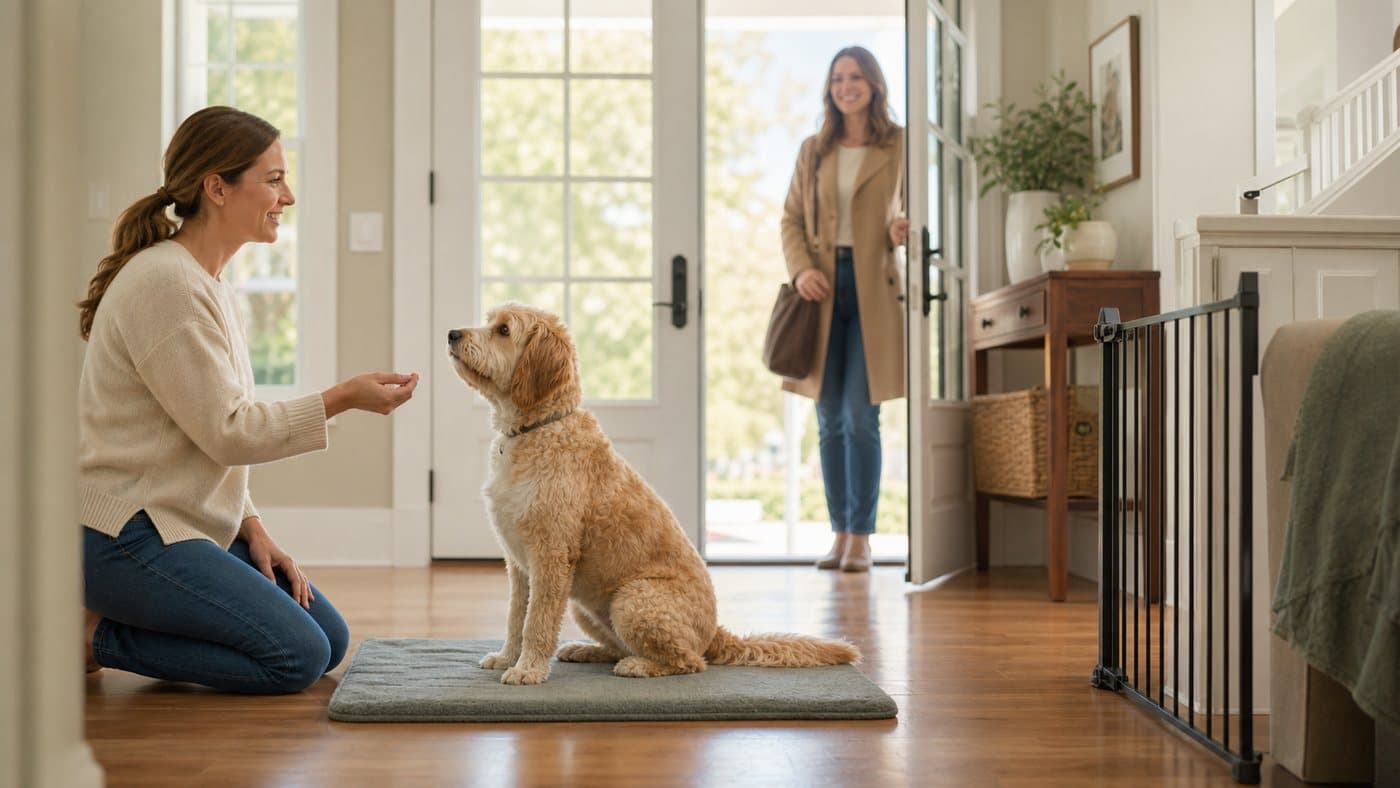
Put a leash, gate, or exercise pen in place before opening the door. Scatter a small handful of food away from the entrance as the guest enters. This lowers the dog's head, breaks the direct rush, and gives you a few seconds to guide them.
Teach a station behavior separately from real arrivals. Practice going to a mat when nothing exciting is happening. Then add mild door sounds, then familiar people, then real guests.
Ask guests to interact only when four paws are on the floor or the dog is on the station. If the dog jumps, the guest turns slightly away and pauses. When the dog lands, calm attention returns.
Use management for fragile guests
If your dog jumps on children, elderly guests, or people with mobility concerns, use management rather than training in the moment. A gate is not a failure. It is how you prevent rehearsal while teaching the new pattern.
Before the guest arrives
The training starts before the doorbell. Put treats near the entry. Decide where your dog will be: behind a gate, on leash, in a pen, or on a mat. Tell the guest the plan before they enter so they do not accidentally reward jumping.
If your dog is already barking and bouncing at the window, the door routine is too late. Move them away from the entry, scatter food, and let arousal drop before any greeting.
Tell guests exactly what to do
Ask guests to enter calmly, avoid direct reaching, and wait until the dog has four paws on the floor. If the dog jumps, the guest turns slightly sideways and pauses. The moment the dog lands, calm attention can return.
For dogs who love people, greeting can be the reward. For dogs who are worried, distance is the reward. Watch body language before assuming your dog wants touch from every visitor.
Make the replacement behavior obvious
"Do not jump" is not a behavior. "Go to mat," "find treats," "touch my hand," or "sit near me" is clearer. Practice the replacement when no one is arriving so your dog has muscle memory before the hard version.
In busy households, keep the door plan visible and repeatable. The more consistent the first 30 seconds are, the faster the jumping loses power.
Practice without real guests
Real guests are usually too exciting for the first training reps. Practice the door routine when no one is coming over. Walk to the door, touch the handle, scatter food behind your dog, and return to normal. Then knock softly from inside the house, send your dog to the mat, and reward. Later, have a family member step outside and come back in calmly.
This separates the pieces: door sound, human movement, mat, food scatter, and greeting. If you only practice when a guest is already entering, your dog is learning during the hardest version.
If your dog jumps harder after being ignored
Some dogs jump harder when the old reward disappears. They may bark, paw, or launch again because jumping has worked for a long time. That does not mean the plan failed. It means the replacement behavior needs to be easier and better paid.
Use more management during this stage. A leash or gate lets guests stay boring while you reward the dog for landing, sniffing, finding treats, or going to a mat. Do not let the dog practice jumping on five people and then expect one ignored jump to change the habit.
Guest arrivals are becoming more predictable
Progress may be one second of four paws on the floor, a faster turn toward the treat scatter, or a dog who can stay behind a gate without barking as long. Count those early wins. Guest manners are built in the first few seconds of the arrival routine, not after the dog has already rehearsed the whole jump-and-greet pattern.
Keep the plan boring and repeatable. Boring is exactly what most doorway chaos needs.