
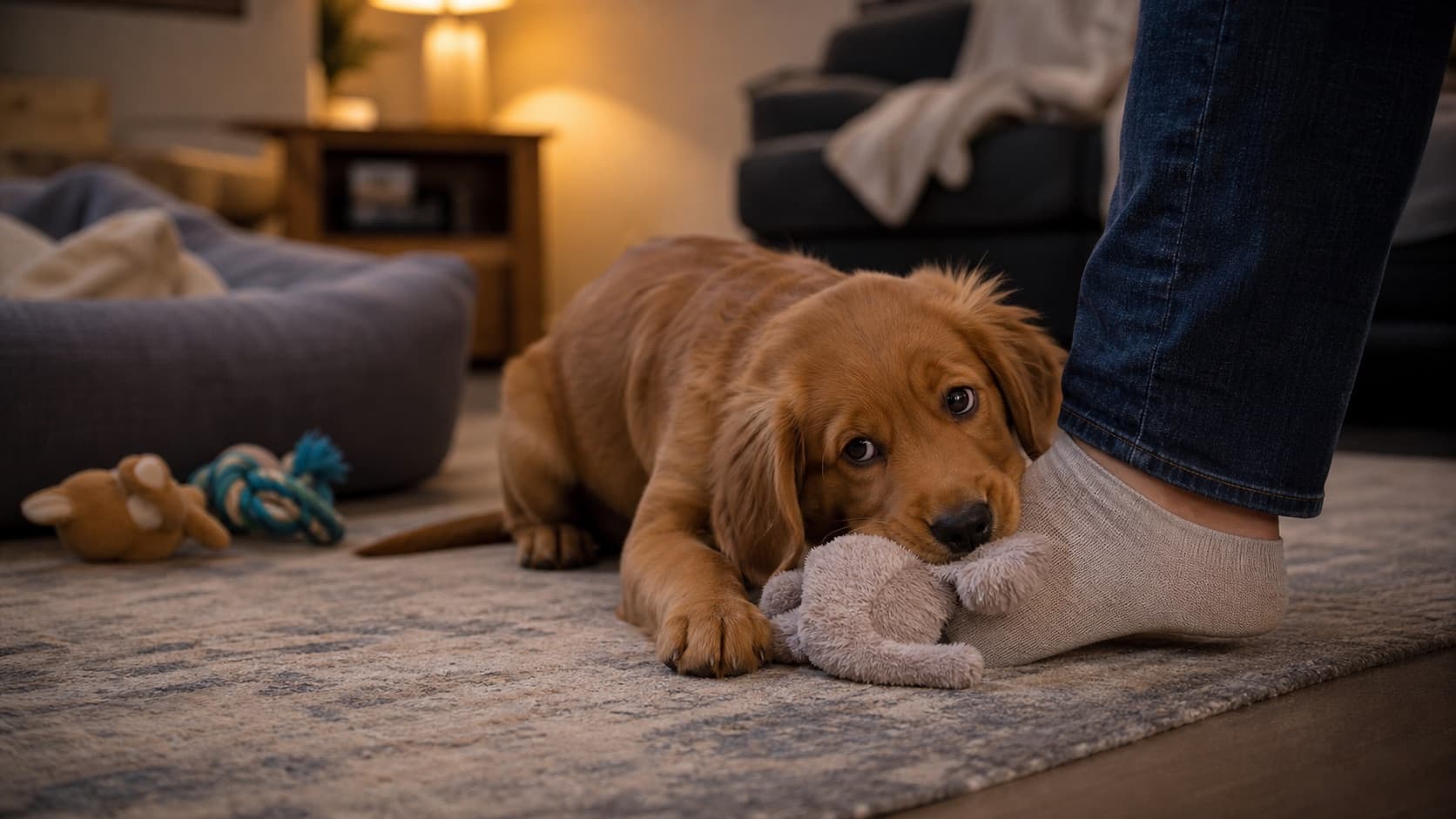
Many puppies bite more when they are tired. That sounds backwards until you live with one. A puppy who needs sleep may zoom across the room, grab sleeves, bite ankles, bark, hump, or launch at hands with more intensity than they showed an hour earlier.
This does not mean your puppy is becoming aggressive. In many cases, tired biting is a sign that the puppy's brain has run out of brakes. Fatigue lowers impulse control. The puppy still wants contact, movement, and relief, but they cannot choose gentle behavior very well.
Why tired puppies bite harder
Young puppies need a lot of sleep. When they stay awake too long, everything gets harder: taking treats gently, responding to cues, disengaging from play, and calming after excitement.
Tired biting often appears in predictable windows. It may happen after dinner, after a long play session, when children come home, during couch time, or right before bedtime. Owners may think, "They still have so much energy," and add more play. That can push the puppy further past the point where settling is possible.
A tired puppy is not always asking for more exercise. They may be asking for help stopping.
What tired biting looks like
Tired biting is often frantic. The puppy may have a loose but wild body, fast movement, grabby mouth, repeated jumping, and difficulty redirecting. They may bite harder than usual, miss the toy and catch skin, or go back to biting as soon as you move.
Some puppies get glassy-eyed or vocal. Others run in circles, dig at blankets, chew furniture, or switch from one behavior to the next without finishing anything.
The key clue is recovery. If the puppy calms after a potty break, a chew, a quiet pen, or a nap, fatigue was probably part of the pattern.
The mistake is adding more excitement
Do not assume tired biting means your puppy is "bad with people." Puppies explore with their mouths, and fatigue makes mouthy behavior messier.
Do not assume more running will fix it. Exercise matters, but overtired puppies often need less stimulation, not a bigger game.
Do not use yelling, pinning, muzzle grabbing, or physical punishment. Those reactions can increase arousal, make hands more exciting or scary, and damage trust.
Watch the pattern over the day
Track wake time for a few days. How long has your puppy been awake before the biting starts? What happened in the previous hour? Was there rough play, visitors, children running, training, grooming, a walk, or missed nap time?
Notice the time of day. Evening biting is extremely common because the puppy has collected stimulation all day. Also notice whether biting happens when people sit on the couch, walk through the room, put on shoes, or try to end play.
If biting is paired with guarding, stiff body language, growling over objects, repeated punctures, or sudden pain signs, treat it as more than normal puppy mouthing and get qualified help.
Begin the cooldown before the wild hour
Plan rest before the meltdown. If your puppy usually bites hard at 7 p.m., begin a calmer routine at 6:30. Bathroom break, short sniffing, quiet chew, dimmer room, and a pen or crate setup close enough that the puppy feels safe.
Use a toy before hands become the target. Long soft toys, tug toys dragged low, or food scatters can move the puppy's mouth away from skin. Keep play short and end before the puppy loses control.
When biting starts, reduce movement. Fast hands and squealing can make the game bigger. Stand still if ankles are the target, offer a toy, scatter a few treats, or calmly guide the puppy to a rest area.
Build a rest routine
Rest is easier when it is predictable. A good routine might be: potty, water, two minutes of gentle sniffing, a chew or lick mat, then quiet time in a pen or crate. Stay nearby at first if your puppy struggles with separation.
Reward calm moments during the day. When your puppy lies down, drop a treat between their paws. When they chew a toy instead of your sleeve, quietly praise and let the toy stay available. Do not wait until the puppy is wild to begin teaching settling.
If your puppy bites children when tired
Use management early. Children move quickly and sound exciting, which makes tired biting more likely. Set up a gate, pen, leash dragging under adult supervision, or separate rest space before the puppy reaches the wild stage.
Children should not be asked to "stand still" as the main plan if the puppy is already biting hard. Adult prevention is safer and fairer. Teach children to trade movement games for tossing treats away from their body or helping place a chew behind a gate.
Use resets, not punishment
A timeout should not be scary. Think of it as a reset, not punishment. If your puppy cannot redirect, calmly guide them to a safe pen with a chew. Keep your voice neutral. The message is: biting ends access to moving bodies, and quiet rest becomes easier.
Short resets work best. If the puppy falls asleep, let them sleep. If your puppy screams, drools, claws, or panics in confinement, the setup is too hard and needs crate or pen comfort work.
When tired biting needs outside help
Most tired biting improves with better nap timing, calmer evenings, redirection, and consistent management. Get help from a vet or qualified trainer if the biting causes repeated punctures, escalates quickly, appears with stiffness or guarding, or does not improve when sleep and routine improve.
The goal is not to stop all puppy mouthiness overnight. The goal is to prevent the overtired spiral and teach your puppy that rest, toys, and calmer contact work better than biting skin.