
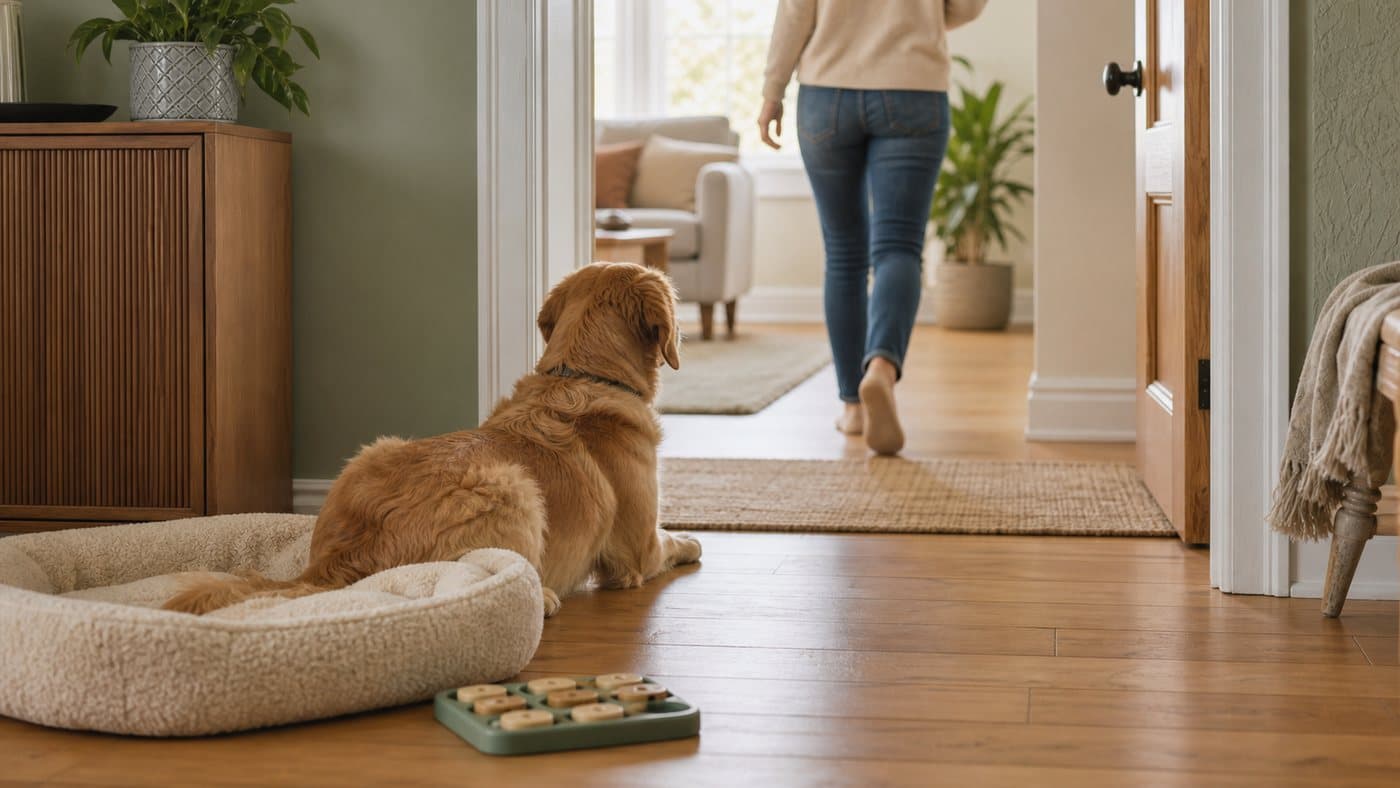
A dog who cries when you leave the room may be frustrated by a barrier, worried about losing access to you, or simply under-practiced at settling alone. The meaning depends on intensity and recovery.
If your dog whines once, waits, and settles, you may be seeing normal attachment. If they pace, scratch, pant, or cannot eat when you are behind a door, the pattern deserves attention.
Run a two-second room test
Try tiny separations while you are home. Step behind a gate for two seconds. Close a bathroom door briefly. Walk into another room while your dog has a safe chew. Does your dog keep working on the chew, or abandon it to cry at the barrier?
Also watch departure cues. If room-to-room crying becomes intense when you put on shoes, pick up keys, or prepare to leave, it may be part of a broader separation-related pattern.
Do not turn practice into panic rehearsal
Do not assume crying is manipulation. It may be communication that the setup is too hard. Also do not rush to long absences as "practice." Practice should be easy enough that the dog stays calm.
Build from boring movements
Build micro-separations. Drop a treat, step away, return before crying. Repeat until the movement becomes boring. Pair resting spaces with calm enrichment while you are still nearby before using them for separation.
If the crying is sudden, paired with pain signs, or appears in a senior dog, start with a veterinary check.
Why room-to-room crying happens
Some dogs cry because they are still learning that separation inside the house is safe. Puppies, newly adopted dogs, and dogs who recently moved homes may follow closely because the routine is not predictable yet. Other dogs cry because they have a deeper separation-related fear and your movement is the first cue that they might be left alone.
Context makes the difference. A dog who whines for a few seconds and then returns to a chew may need practice with independence. A dog who cannot eat, scratches the door, pants, or panics when you step into the bathroom may need a slower plan.
Do not measure the problem only by volume. Quiet pacing and staring at the door can be just as meaningful as crying.
Practice independence while you are home
Start when your dog is already calm. Give a simple activity, such as a scatter of kibble, a lick mat, or a chew, while you sit nearby. Then stand up, take one step, and return before your dog follows. Repeat until your movement is boring.
Next add easy barriers. Step over a baby gate and come right back. Close a door for one second. Walk to the mailbox while another person stays inside if that helps. Keep the repetitions short enough that your dog remains successful.
If your dog cries, make the next version easier. The goal is not to teach them to cry until you return. The goal is to create many tiny examples of "my person moves away and nothing bad happens."
Avoid accidentally intensifying it
Big greetings after every tiny separation can make your return feel like a major event. Keep departures and returns warm but low-key. Also avoid saving all enrichment for the moment you leave; practice calm alone-adjacent activities while you are still visible.
Get help if the crying escalates to destruction, drooling, house soiling, escape attempts, self-injury, or inability to be alone for necessary routines. Separation distress is common, and a customized plan is often kinder than trial and error.
Barrier frustration or true worry?
Some dogs cry because a barrier blocks access to something they want. They may be bright, alert, and frustrated rather than panicked. Others cry because your absence feels unsafe. They may pace, pant, refuse food, scratch, or stay glued to the door.
The distinction matters. Barrier frustration often improves when the dog has a job, a practiced mat, or a clearer routine. True separation-related worry needs slower absence work and careful monitoring.
Build an "alone while together" skill
Before leaving the room, teach your dog to relax near you without constant contact. Place a mat a few feet away, reward calm settling, and occasionally stand up and sit down again. Then take one step away, return, and reward the dog for staying relaxed.
This is not about ignoring your dog. It is about showing them that small changes in your movement are ordinary. Dogs who can rest while you move nearby often handle room-to-room separation more easily later.
Use doors gently
Doors are powerful cues. If the bathroom door, bedroom door, or office door always predicts distress, practice with the door in tiny pieces. Touch the handle, reward. Open the door, reward. Step through and return immediately. Close it for one second only when the earlier steps are boring.
If crying starts, the step was too big. Make the next version easier instead of turning the door into a daily panic trigger.
Room-to-room separations are getting easier
Progress may look like your dog finishing a chew while you stand up, staying on a mat when you step into the hall, or crying for one second and then sniffing instead of escalating. These are small, but they matter. Calm room-to-room separation is built from many easy repetitions.
Keep notes for a week. If the easy steps keep getting easier, continue. If the crying spreads to every movement you make, slow down and consider separation-focused help.